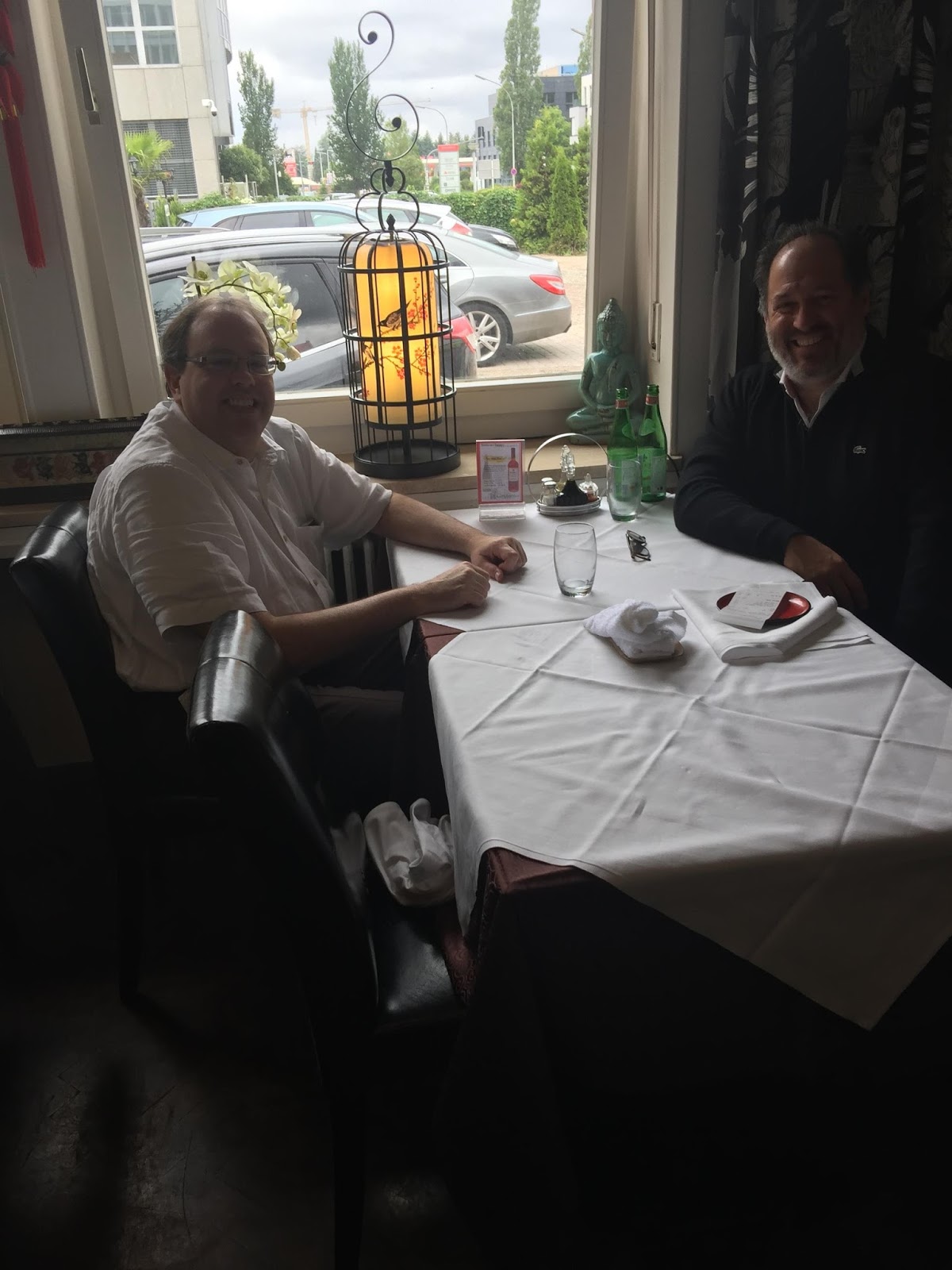
Mr. Ralph Winnie and Mr. William Yale
The State of U.S.-China Relations
Wednesday, August 2nd, 2017
Author: William Mallard
(Audio + Talk)
Ralph
Winnie is a partner of Henson, Pang and Winnie, a premier international
law firm and consulting group with offices in Washington, D.C. in the
United States and Shanghai in China. He also serves as Director of the
China Program for the Eurasia Center and its Eurasian Business
Coalition, an organization dedicated to promoting and preserving the
ideas of affordable housing, economic cooperation, environmental
sustainable development and the promotion of business development, tax
and trade between the United States and the fifty-nine nations
comprising Eurasia. Mr. Winnie has extensive experience in international
affairs, international business development and trade, and domestic and
international tax policies. Mr. Winnie has held many prominent
positions including most recently: Director of the China Program for the
Eurasia Center; Vice-President of Global Business Development for the
Eurasian Business Coalition; and countless board positions for
international organizations. William Yale is an Adjunct Fellow at the
American Security Project and a Research Associate at the SAIS Foreign
Policy Institute (FPI). He has previously worked at the U.S. Naval War
College and the State Department.
Mr. Winnie and Mr. Yale came to
the DACOR Bacon House to hold an Q&A session concerning the subject
of the general state of U.S.-Chinese relations and included issues such
as the South China Sea, North Korea, and the Trump administration. Mr.
Yale’s first question was on Mr. Winnie’s views concerning the Trump
administration’s impact on the U.S.-China relationship. Mr. Winnie
responded stating that President Trump’s views of China have been
characterized by strong language but that his focus has been on
developing bilateral relationships and negotiations, as opposed to the
strong focus on multilateral deals and relationships from previous
administrations. Hence the U.S.’ removal of itself from the
Trans-Pacific Partnership, which President Trump viewed as detrimental
to the U.S. Despite the consistent amount of goodwill still in Asia
towards the U.S., Mr. Winnie stated that the Trump administration’s
words and actions could erode said goodwill. Thus, while initial
U.S.-China relations haven’t deteriorated overmuch, China is having to
reexamine its relationship strategy and is therefore looking to expand
its relationships and alliances with other entities such as the EU.
Mr.
Yale then switched subjects and asked whether there were any levers
through which the U.S. and China could work together towards a solution
concerning North Korea. Mr. Winnie responded by stating that some
possible solutions for the U.S. are that it could penalize the Chinese
banks that are connected to various Chinese front companies that smuggle
goods to North Korea. As well, the U.S. has several issues through
which it can influence China such as Taiwan, the islands in the South
China Sea, and issues concerning the Chinese-Indian border. The
discussion then examined ways in which the U.S. can respond to China’s
human rights record. Mr. Winnie then explained that the U.S., while it
should be confident in its projection of its soft power abroad and
should work to promote democracy and freedom within China, must maintain
a sense of wariness and caution, since the Chinese don’t want to bow to
foreign interference in their domestic affairs.
The discussion
then changed gears and focused on the South China Sea. Mr. Winnie
reviewed the U.S.’ interests in the South China Sea and emphasized
differing scenarios based upon the U.S.’ strategy in the
region.
As an illustration, if the U.S. wishes to maintain its status as the
global hegemon, it must be committed to maintaining large numbers of
military forces in the region to dissuade China’s military advances and
reassure America’s regional allies. If not, Mr. Winnie stated that the
U.S. should commit to no more than ensuring access to free seas for
maritime trade and should sit back and let China continue to develop and
rise in power. Mr. Winnie did state further that the U.S. had too many
interests in the region to affect a pullback and could not afford to
resign its commission as the global hegemon, which would necessitate
increased military cooperation with its regional allies to hedge against
a swiftly rising China.
Mr. Yale followed up with a question
concerning the new U.S. ambassador to China and his thoughts on the
perceived effectiveness of the new diplomat, to which Mr. Winnie
responded by stating that the ambassador was a good pick with extensive
knowledge and experience of Chinese relations and culture. Mr. Winnie
went further, stating that this new ambassador has a long-standing
commitment to the principles of free trade and will be able to foster
long-term relationships with the Chinese government. As well, Mr. Winnie
believes that the new Secretary of State will be able to use his
experience leading a large, multinational corporation to forge strong
ties with the Chinese leadership. Finally, Mr. Yale asked Mr. Winnie
about his opinions concerning China’s upcoming Party Congress in the
Fall, to which Mr. Winnie replied that China’s top leader, Xi Jingping,
is the most powerful and influential leader that China has seen in
decades and will most likely continue to solidify his power when the
Chinese government next convenes.
Mr. Winnie and Mr. Yale then
concluded the initial portion of their discussion by taking questions
from the audience. One question concerned Mr. Winnie’s perspective on
the perceived ties between President Putin and Xi Jingping, to which he
replied that, while the two leaders both respect each other and have
forged closer ties, the Russian and Chinese peoples don’t hold each
other in very high esteem, making their partnership one built on shaky
foundations. As well, Mr. Winnie spoke on China’s use of its soft power,
particularly through its cultivation of the One Belt, One Road
initiative. He sated his belief that the global banking system needs to
be liberalized and that the U.S. must continue to cultivate
relationships with other Asian states. Mr. Winnie concluded the
discussion with a brief set of remarks concerning President Trump’s
foreign policy. He stated that Mr. Trump approaches his foreign-policy
decision-making from the perspective of a business-man focused on
bilateral business deals. Thus, the expectations of Mr. trump to become a
diplomat are largely unfounded as he will continue to conduct deals on a
case-by-case basis like the businessman that he in fact is.
Ralph Winnie Jr. with the Mongolian President

Tuesday, August 8, 2017

Wednesday, August 2, 2017


Saturday, July 22, 2017
Ralph Winnie, Jr. quoted in Sputnik News-Significance of Huntsman's appointment as next US ambassador to Moscow
 00:13 22.07.2017 ©
AP Photo/ Matt Rourke

Huntsman Expected to Bring Bipartisan Support to Post as Ambassador to Russia
New US Ambassador to Russia Jon Huntsman has worked for both Republican and Democratic presidents and won the respect and trust of legislators from both parties in Congress so is expected to bring a non-ideological approach to the position, analysts told Sputnik.
WASHINGTON (Sputnik) — The White House announced Huntsman’s appointment on Wednesday, even though he had previously sharply criticized Trump during the 2016 presidential campaign. He has also helped lead a family chemicals company that conducts business in Russia
HUNTSMAN’S RECORD COMMANDS RESPECT AMONG US POLITICIANSHuntsman has served in every US presidential administration since Ronald Reagan in the early 1980s and was CEO of his family-owned Huntsman Corporation.
"Huntsman is very credible choice for the
post," Eurasian Business Coalition Vice President Ralph Winnie told
Sputnik on Friday. "He has mutual respect on both sides of the aisle."
Huntsman served as a White House staff assistant for Reagan then
became Deputy Assistant Secretary of Commerce and US Ambassador
to Singapore under Reagan’s Republican successor President George H.W.
Bush.In a career of national prominence lasting more than three and a half decades, Huntsman had compiled a spotless record of personal trust and integrity, Winnie stated.
"No scandals and very knowledgeable about international affairs," he said
Huntsman’s record included negotiating China’s entry into the World
Trade Organization (WTO) in 2001 and serving as President Barack Obama’s
ambassador to Beijing, Winnie recalled.Huntsman is a Republican moderate and pragmatist who will work hard to develop good relations between Washington and Moscow, Winnie explained.
"He has the ability to negotiate effectively," he said.
HUNTSMAN BUSINESS EXPERIENCE SEEN AS POSITIVE FACTOR
Like Secretary of State Rex Tillerson, the longtime former Chairman and CEO of Exxon Mobil, Huntsman already had experience of doing business in Russia before his latest appointment.
Former Brown University Assistant Professor of Economics Barry Friedman agreed that Huntsman’s extensive business background was likely to be a major advantage for his effectiveness as ambassador to Moscow.
"Is it so unusual to have a business leader
appointed as an Ambassador? I think not, and he has already served
in that capacity," he said.
Friedman explained that independent wealth often meant a diplomat was
more independent and secure and less likely to be swayed by issues
of personal profit in his professional duties.
"You don't want someone of modest means and hungry who would perhaps be even more vulnerable to influence," he said.
Allegations that Huntsman might face conflict of issues criticism
because of his previous business dealings in Russia did not appear to be
a serious problem for his confirmation by the Senate, Friedman noted.
"I don't know if you can ever 100 percent prove
the absence of a conflict of interest. You could have assets put in a
blind trust, but informal understandings might be reached that reward a
person later," he remarked.
While Huntsman was expected to play a constructive role in setting a
positive tone in personal diplomacy with Russian officials, the
structure of the US government meant he was not likely to be a decisive
figure in setting policy toward the Kremlin, Freidman cautioned.
"The Ambassador does not usually make policy
between countries: More likely an Ambassador would not have the
resources of the National Security Council and the Secretaries of State
and Defense when it comes to critical information to advise the
President," he noted.
US ambassadors had made a much greater difference in shaping policies
towards major powers decades ago before the vast expansion of the
National Security Council’s centralizing bureaucracy and the State
Department’s increasing micro-management of diplomatic activities,
Friedman recalled.
"Maybe Averill Harriman [US ambassador to the
United Kingdom and the Soviet Union during World War II] But Ambassadors
making a critical difference in shaping policies? Increasingly rare,"
he said
However, Huntsman’s extensive diplomatic and business experience
meant he was likely to already enjoy an extended circle of friends and
contacts in Moscow that could make him far more effective as a
bridge-builder between the two governments, Friedman pointed out."To convey useful information it would help to build up some trustworthy high-level connections so the fact that he has had some business operations in Russia before may even be a plus," he suggested.
Ralph Winnie, Jr. quoted in Sputnik News-Significance of Huntsman's appointment as next US Ambassador to Moscow
Huntsman Expected to Bring Bipartisan Support to Post as Ambassador to Russia
©
AP Photo/ Matt Rourke
New
US Ambassador to Russia Jon Huntsman has worked for both Republican and
Democratic presidents and won the respect and trust of legislators from
both parties in Congress so is expected to bring a non-ideological
approach to the position, analysts told Sputnik.

©
AFP 2017/ PAUL J. RICHARDS
Huntsman has served in every US presidential administration since Ronald Reagan in the early 1980s and was CEO of his family-owned Huntsman Corporation.
"Huntsman is very credible choice for the
post," Eurasian Business Coalition Vice President Ralph Winnie told
Sputnik on Friday. "He has mutual respect on both sides of the aisle."
Huntsman served as a White House staff assistant for Reagan then
became Deputy Assistant Secretary of Commerce and US Ambassador
to Singapore under Reagan’s Republican successor President George H.W.
Bush.In a career of national prominence lasting more than three and a half decades, Huntsman had compiled a spotless record of personal trust and integrity, Winnie stated.
"No scandals and very knowledgeable about international affairs," he said
Huntsman’s record included negotiating China’s entry into the World
Trade Organization (WTO) in 2001 and serving as President Barack Obama’s
ambassador to Beijing, Winnie recalled.Huntsman is a Republican moderate and pragmatist who will work hard to develop good relations between Washington and Moscow, Winnie explained.
"He has the ability to negotiate effectively," he said.
HUNTSMAN BUSINESS EXPERIENCE SEEN AS POSITIVE FACTOR
©
AP Photo/ Matt Rourke
"Is it so unusual to have a business leader
appointed as an Ambassador? I think not, and he has already served
in that capacity," he said.
Friedman explained that independent wealth often meant a diplomat was
more independent and secure and less likely to be swayed by issues
of personal profit in his professional duties.
"You don't want someone of modest means and hungry who would perhaps be even more vulnerable to influence," he said.
Allegations that Huntsman might face conflict of issues criticism
because of his previous business dealings in Russia did not appear to be
a serious problem for his confirmation by the Senate, Friedman noted.
"I don't know if you can ever 100 percent prove
the absence of a conflict of interest. You could have assets put in a
blind trust, but informal understandings might be reached that reward a
person later," he remarked.
While Huntsman was expected to play a constructive role in setting a
positive tone in personal diplomacy with Russian officials, the
structure of the US government meant he was not likely to be a decisive
figure in setting policy toward the Kremlin, Freidman cautioned.
"The Ambassador does not usually make policy
between countries: More likely an Ambassador would not have the
resources of the National Security Council and the Secretaries of State
and Defense when it comes to critical information to advise the
President," he noted.
US ambassadors had made a much greater difference in shaping policies
towards major powers decades ago before the vast expansion of the
National Security Council’s centralizing bureaucracy and the State
Department’s increasing micro-management of diplomatic activities,
Friedman recalled.
"Maybe Averill Harriman [US ambassador to the
United Kingdom and the Soviet Union during World War II] But Ambassadors
making a critical difference in shaping policies? Increasingly rare,"
he said
However, Huntsman’s extensive diplomatic and business experience
meant he was likely to already enjoy an extended circle of friends and
contacts in Moscow that could make him far more effective as a
bridge-builder between the two governments, Friedman pointed out."To convey useful information it would help to build up some trustworthy high-level connections so the fact that he has had some business operations in Russia before may even be a plus," he suggested.
Wednesday, July 12, 2017
Sunday, July 2, 2017
Thursday, June 8, 2017
Thank you Letter from Anthony Livanios regarding Ralph Winnie, Jr. participation in the 3rd Annual Washington Oil & Gas Forum
Dear Ralph Winnie,
I would like to thank you for your participation to the 3rd Washington Oil & Gas Forum 2017, that was held on June 7th and 8th at the Cosmos Club in Washington, DC. I hope your participation in this event helped you gain valuable information and provided ample opportunities for you to network and develop relationships with speakers and attendees.
Among the distinguished speakers of the Forum were:
Hon. Rob Bishop, U.S. Representative (R-UT)
Hon. Gus Bilirakis, U.S. Representative (R-FL)
Hon. Bill Flores, U.S. Representative (R-TX)
Hon. Scott Taylor, U.S. Representative (R-VA)
Hon. Robin Dunnigan, Deputy Assistant Secretary, U.S. Department of State
George Sifakis, Director for the Office of Public Liaison, The White House
Rob Smith, Acting Deputy Assistant Secretary, U.S. Department of Energy
Hon. Kathleen A. Doherty, U.S. Ambassador to Cyprus
This year’s forum attracted a distinguished line-up of the most influential US Congressional, Government and White House leaders and senior oil and gas executives. My aim is to promote American investments domestically and internationally in the oil & gas industry and to help make America energy independent.
The Washington Oil & Gas Forum took place at a critical moment for the American oil and gas industry, as last week President Trump on his statement announced that the United States ceased all implementation of the Paris Climate Agreement. This Agreement imposed energy restrictions that result in financial and economic burdens to the United States. The off the record and non-attribution discussions at the Forum, enabled the dissemination of market insight regarding the energy policy of the Trump Administration and its impact on the global energy markets. The speakers presented their views on topics such as deep offshore drilling, shale gas, LNG and crude oil exports, energy infrastructure, regulatory challenges, and tax reform. Over the last two days Congressional, White House, and Government decision makers along with American and international energy leaders discussed on the impact of President Trump's decision on the global energy markets.
I would like to express my gratitude to our Bronze Partners: ENI and Poten & Partners. Furthermore, my sincere thanks to our Knowledge Partners: Americans for Tax Reform (ATR), Energy Policy Research Foundation (EPRINC), and ESCP Europe Business School London, and to all our speakers and attendees who are participating in this year’s Forum!
U.S. Energy Stream and myself would like to thank you once again for your participation and contribution to the success of the Forum.
CEO
I would like to thank you for your participation to the 3rd Washington Oil & Gas Forum 2017, that was held on June 7th and 8th at the Cosmos Club in Washington, DC. I hope your participation in this event helped you gain valuable information and provided ample opportunities for you to network and develop relationships with speakers and attendees.
Among the distinguished speakers of the Forum were:
Hon. Rob Bishop, U.S. Representative (R-UT)
Hon. Gus Bilirakis, U.S. Representative (R-FL)
Hon. Bill Flores, U.S. Representative (R-TX)
Hon. Scott Taylor, U.S. Representative (R-VA)
Hon. Robin Dunnigan, Deputy Assistant Secretary, U.S. Department of State
George Sifakis, Director for the Office of Public Liaison, The White House
Rob Smith, Acting Deputy Assistant Secretary, U.S. Department of Energy
Hon. Kathleen A. Doherty, U.S. Ambassador to Cyprus
This year’s forum attracted a distinguished line-up of the most influential US Congressional, Government and White House leaders and senior oil and gas executives. My aim is to promote American investments domestically and internationally in the oil & gas industry and to help make America energy independent.
The Washington Oil & Gas Forum took place at a critical moment for the American oil and gas industry, as last week President Trump on his statement announced that the United States ceased all implementation of the Paris Climate Agreement. This Agreement imposed energy restrictions that result in financial and economic burdens to the United States. The off the record and non-attribution discussions at the Forum, enabled the dissemination of market insight regarding the energy policy of the Trump Administration and its impact on the global energy markets. The speakers presented their views on topics such as deep offshore drilling, shale gas, LNG and crude oil exports, energy infrastructure, regulatory challenges, and tax reform. Over the last two days Congressional, White House, and Government decision makers along with American and international energy leaders discussed on the impact of President Trump's decision on the global energy markets.
I would like to express my gratitude to our Bronze Partners: ENI and Poten & Partners. Furthermore, my sincere thanks to our Knowledge Partners: Americans for Tax Reform (ATR), Energy Policy Research Foundation (EPRINC), and ESCP Europe Business School London, and to all our speakers and attendees who are participating in this year’s Forum!
U.S. Energy Stream and myself would like to thank you once again for your participation and contribution to the success of the Forum.
I look forward to welcoming you to future oil and gas Forums!
Best Regards,
Anthony LivaniosCEO

Thursday, June 1, 2017
China-US Chamber of Commerce Thank You to Ralph Winnie, Jr.
Dear Ralph,
On
Behalf of the China-US Chamber of Commerce, we would like to thank you
for attending the “China(Guizhou)-U.S.(New York) Investment and Trade
Promotion Conference” on June 1st, 2017 at the New York Marriott Downtown.
We
hope that you found the conference informative and worthwhile. The
primary goal of this conference was to showcase the stunning development
in today’s Guizhou, and to inform and offer the many exciting business
opportunities in the province for many US companies.
Your
presence helped to make this event a great success and we enjoyed
spending time together. We wish you all the best and hope to see you
soon at our next event!
Best regards,

Mingyi Xu
Vice President
China-U.S. Chamber of Commerce
Thursday, May 25, 2017
Media Update
The Committee of 100 performed a survey to determine Americans attitude towards China and vise versa.
Important Date to Note being:
Both Chinese and Americans view the other less favorably now than in 2012
Only 15% of Chinese trust Americans down from 35% in 2012
Both agree on U.S.-China collaboration seeing benefits if both work together
Both care about environmentalism greatly 60% - Americans 79% - Chinese
China worries about American Military Presence in Asia 79% seeing it as a threat
Both America and China see trade relations as a top priority
Essentially,
both Chinese and Americans are willing to work together on trade more
than anything else, although there is still a lack of trust on both
sides. The public opinion change while it could have a small impact
seemed to be relatively similar in nature.Both Chinese and Americans view the other less favorably now than in 2012
Only 15% of Chinese trust Americans down from 35% in 2012
Both agree on U.S.-China collaboration seeing benefits if both work together
Both care about environmentalism greatly 60% - Americans 79% - Chinese
China worries about American Military Presence in Asia 79% seeing it as a threat
Both America and China see trade relations as a top priority
-------------------------------------------------------------------------------------------------------------------------
NEWS RELEASE
Committee of 100
Releases 2017 U.S.-China Public Perceptions Survey
Survey finds that
rising levels of distrust could undermine the U.S.-China relationship, Bridge-building
required to ease concerns
Washington, D.C., May
19, 2017 –
A new survey conducted by the Committee of 100 (C100) – a non-profit
organization of prominent Chinese American leaders from politics, business,
media and entertainment, and academia – underscores that a majority of
Americans view cooperation and bridge-building between the two countries as
“critical” and recognize the benefits of increased trade and investment, and
cultural exchanges. Americans are, however, wary of China’s economic and military
intentions.
According to C100’s Chairman Frank Wu, the C100’s landmark survey
is intended to provide unique, comprehensive, and comparative information to
better understand and enhance U.S.-China relations. The report also allows for
a comparison of attitude changes over the last decade in both the U.S. and China
“The aim of this survey is to determine American attitudes toward
China, and Chinese attitudes toward the United States, in order to explore the
most salient issues in U.S.-China relations. Now more than ever, it is more
crucial than ever to find paths to mutual understanding and stronger bilateral
relations. The study illuminates the hopes and fears of Americans and Chinese
people for U.S.-China relations, and can be used to foster more fact-based
dialogue and decision-making,” said Wu.
The Committee of 100's Public Perceptions Opinion Survey project
began in 1994 and produced reports in 2001, 2005, 2007, 2012, and 2017. The
report covered 79 questions showing responses in China and the United States
from four target respondent groups: the general public, business leaders,
policy experts, and journalists.
Key highlights:
·
The survey found that
favorable views of the other country have declined: 55% of Chinese say they have a favorable
impression of the U.S., down from 59% % in 2012, while 48% of Americans have a
favorable view of China, down from 48% in 2017.
·
Chinese have become less trusting of America: Only 15% of Chinese think China should trust America, down from 36% in
2012.
·
However,
Americans and Chinese also agree on areas of U.S.-China Collaboration:
For the first time, Americans and Chinese are in agreement
about the areas in which both countries would benefit from working together:
trade, global financial stability, and the environment. In addition, North
Korea has proved to be a common area of concern and desired collaboration.
·
Chinese Optimism at All Time High: More Chinese than ever
(92%) think China is headed on the right track, with a majority believing China
will surpass the U.S. as the world’s leading superpower.
Other findings from the survey include:
● Concerns about cybersecurity are
on Americans’ minds. Americans cite cybersecurity as the top likely
source of conflict between the two countries, along with trade. Concern for the threat of cybersecurity
doubled in importance for Americans from 11% in 2012 to 24% in 2017.
● China has serious concerns about
the United States’ military presence in Asia. 79% of Chinese see
America’s military power as a potential to serious threat. 72% see the disputes
over the claims in the South China Sea as a regional issue rather than an
international one.
● Environmental concerns are at an
all-time high when it comes to individuals. 60% of Americans and 79%
of Chinese (the highest percentage yet in the last decade) personally worry
about climate change.
● U.S. - Chinese trade relations
are a top priority. Over 80% of both Americans and Chinese agree that
trade with China is beneficial to the U.S. economy. Both Americans (75%) and
Chinese (74%) also agree that products from China benefit American
consumers.
● Millennials in the United States
driving up support for China. 72% of American millennials value China
as the most important partner compared to 64% of the general public.
● Despite these challenges, both
American and Chinese citizens want to be invested in each other’s future.
88% of American millennials think positively of the Chinese language being
taught in U.S. schools (82% general public)’ and 86% (78% general public) think
the increase of Chinese students studying in the U.S. is good for America.
Methodology:
The survey, conducted in English in the U.S. in collaboration with
Brunswick Insights, was released during the C100 Annual Conference 2017 in
Washington, D.C. on May 19, 2017. The data for the national China survey was
drawn from Horizon Dataway’s own continuous self-sponsored and annually
released survey on China’s global views, “The World in Chinese Eyes.”
The latest survey covered 79 questions, 53 of which were asked in
both the U.S. and China, 11 in the United States only, and 15 in China only.
About 80% of the survey questions in this update were repeated from the 2012
survey. This year, the survey was conducted among 3,696 Chinese respondents and
1,019 American respondents between November 18 and December 23, 2016.
About the Committee of 100
The Committee of 100 is an international, non-partisan leadership
organization of prominent Chinese Americans in business, government, academia,
and the arts. For over 25 years, the Committee has been committed to a dual
mission of promoting the full participation of Chinese Americans in all fields
of American life, and encouraging constructive relations between the peoples of
the United States and Greater China. www.committee100.org.
About Brunswick Group
Brunswick Insight is
Brunswick’s specialist opinion research practice, focused on understanding the
views of opinion formers around the world. Brunswick Group is an advisory firm
specializing in critical issues and corporate relations. Founded in 1987,
Brunswick is an organically grown, private partnership with 23 offices around
the world.
----------------------------------------------------------------------------------------------------------------------------------------------
Wednesday, May 17, 2017
Ralph Winnie, Jr. and Senator Mazie Hirono of Hawaii in May 2017
 |
| Ralph Winnie, Jr and Senator Mazie Hirono Share a Quick Moment During a Talk Story Event. |
Friday, May 12, 2017
On May 12th, 2017 Ralph E. Winnie, Jr. was invited by the China Council for the Promotion of International Trade
On May 12th, 2017 Ralph E. Winnie, Jr. was invited by the China Council
for
the Promotion of International Trade to meet with a delegation from the
People's Republic of China representing the China Petroleum and
PetroChemical Engineering Institute
Dear Ralph,
Hope
this e-mail finds you well. It is with great pleasure to advice you
that a Chinese delegation composed of chemical enterprises is coming to
DC on Friday
May 12, 2017. The delegation is led by the China Petroleum and
Petrochemical Engineering Institute, and they will be in Philadelphia
next week to participate in the InformEx 2017, a three-day show event in
innovation chemical industry.
We are planning to held a workshop and briefing in our office this Friday afternoon (15:00-17:00). And we’d like to invite you to meet and discuss business cooperation on US-China chemical trade and investment.
Please let me know if you interested in attending and meeting with the delegation.
Looking forward to your confirmation.
Regards,
The namelist of the delegation is as follows,
Name
|
Position
|
Organization
|
Mr. Wang Wenke
|
Overseas Manager
|
Beijing United Media Information Technology Co., Ltd
|
Mr. Zhao Xiaoqing
|
President
|
Shanxi Yushe Chemical Corporation
|
Mr. Bai Yaobin
|
Vice President
|
Shanxi Yushe Chemical Corporation
|
Mr. Zhang Bin
|
Chairman
|
Wuhu Ronghui Chemical Corporation
|
Mr. Zhang Siqi
|
Vice General Engineer
|
Wuhu Ronghui Chemical Corporation
|
Mr. Zheng Chunguang
|
General Manager
|
Wuhu Ronghui Chemical Corporation
|
Mr. Wang Wensheng
|
Chairman
|
Inner Mongolia Chenhongli Chemical Co., Ltd
|
Mr. Ma Bin
|
President
|
Inner Mongolia Meidao Technology Co., Ltd
|
Mr. Wang, Zhonghe
|
Assistant To President
|
Inner Mongolia Chenhongli Chemical Co., Ltd
|
Ms. Bai, Jie
|
General Manager
|
Beijing Chenhongli Chemical Technology Co., Ltd
|
Ms. Huang, Danqing
|
General Manager
|
Wuhu Ronghui Chemical Corporation
|
Ms. Zhang, Ling
|
General Manager
|
Beijing Zhongtai Qili International Trading Co., Ltd
|
Ms.Yao, Ya
|
Vice General Manager
|
Shandong Taihe Water Treatment Corporation
|
Ms.Wang, Jinrong
|
President
|
Tianjin Xiangyue Sealing Materials Co., Ltd
|
Mr. Chen, Zhaomin
|
President
|
Inner Mongolia Chenhongli Chemical Co., Ltd
|
Mr. Peng, Lang
|
Vice President
|
Sichuan Jinlu Group
|
Mr. Xiao, Ying
|
Vice President
|
Sichuan Jinlu Group
|
Mr. Wang Zhiguo
|
General Manager
|
Sichuan Jinlu Group
|
Wednesday, May 10, 2017
Monday, May 8, 2017
Link to Sputnik News Interview of Ralph Winnie, Jr - March 2017


Senators Call for Probe Into US Assault on Traditional Values in Other Nations
Six US senators wrote a letter to Secretary of State Rex Tillerson this week calling for an investigation into the Obama administration’s funding for so-called progressive causes and radical groups undermining traditional values and legitimate governments in other countries, analysts told Sputnik.
WASHINGTON (Sputnik) — Historian and international affairs commentator Matthew Dal Santo told Sputnik that the issue brought up in the letter from the senators is of a "real concern," as money of US taxpayers is being used to further a "progressive agenda just about wherever there is a US embassy around the world."
On Tuesday, a group of US Senators led by Mike Lee from the state of Utah called on Tillerson to investigate US embassies funding political factions within other sovereign nations, including through a George Soros-backed organizations funded by the US Agency for International Development (USAID).
"The recent case of Macedonia springs to mind,
where USAID last year used $300,000 to promote an 'LGBTI
[Lesbian-Gas-Bisexual-Transgender-Intersex] ‘Inclusion Project' that
would inevitably run counter to the teachings of the local Orthodox
Church, the biggest religious group in the country," Dal Santo said
on Thursday.
The senators’ letter specifically mentioned Macedonia, where credible
organizations have noted US and EU direct interference in the country’s
political process by aiding leftist and radical groups to foment
unrest, as well as interfere in elections, courts and the media.
"Perhaps those countries should be allowed
to go through a process of public discussion and decide for themselves
what is right for them — just as the US has done on this issue —
without the government of the United States deciding that it already
knows what's best for them?" Dal Santo suggested.
Under Obama, the US government intervened in Macedonia and other
countries through USAID funds given to Soros’ foundations and other
nominally non-governmental entities. The US embassy, either via the
Soros network or otherwise, used taxpayer funds to pressure officials,
meddle in elections and courts, impose media censorship and otherwise
undermine the country’s government, according to published reports.
The Macedonians have been particularly incensed that the Soros
network has promoted the so-called "Tirana platform," calling for a
bilingual, federalized Macedonia split into an Albanian and Macedonian
part, which could lead to a subsequent partition of the country. More
than 150,000 Macedonian have demonstrated in the past two weeks daily
in Skopje and 30 other towns in opposition to the Tirana platform.
"The argument isn't about whether such a cause
is or isn't right or worthy. It's about the US seeking to export Western
beliefs and values to societies with different, more traditional
values," Dal Santo explained.
The senators’ letter identified the growing problem of rival factions
within the US federal government competing to promote rival and
polarized agendas and ideologies, Eurasian Business Coalition Vice
President Ralph Winnie warned.
"The problem now is you have got competing
interests in the US government — conservative and liberal. Therefore you
have the danger that successive or alternative factions in government
will promote conflicting and contradictory policies. If that happens,
you are going to have a lot of problems," he said.
The United States needs to have a consistent foreign policy with a consistent message, Winnie explained.
"That is the problem: We haven’t had a consistent message," he said.There was a strong feeling in many countries around the world that elites were controlling the agenda against the interests of ordinary people, Winnie noted.


Sunday, April 30, 2017
Saturday, April 29, 2017
China courts region as Trump pulls back on free trade
Is it the end of free trade as we know it? After a campaign where he promised the return of jobs lost abroad, Donald Trump announced that on day one of his presidency he'll scrap the Trans-Pacific Partnership. Will US workers be better off with it or without it? Russia and China, both left out of TPP, see reason to smile. Could this lead to a new era of protectionism or even a trade war?
Original Link: http://www.france24.com/en/20161122-debate-trump-trade-tpp-china-part-one
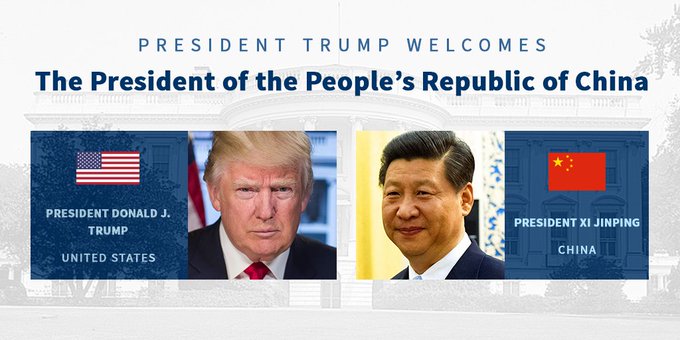
China’s Xi arrives in Florida ahead of ‘difficult’ talks with Trump
President Donald Trump opens a high-stakes summit Thursday with Chinese President Xi Jinping, with the threat of nuclear North Korea and trade on the agenda for the first meeting between the leaders of the world's two largest economies.
The leaders were arriving in South Florida separately Thursday afternoon for the summit at Trump's Mar-a-Lago estate, a location the White House said was selected to give the two days of discussions a more relaxed feel.
Xi landed in West Palm Beach, Florida, and was greeted by Secretary of State Rex Tillerson. Trump and Xi, joined by their wives, were slated to attend a welcome dinner Thursday night, followed by policy discussions on Friday.
Both as a candidate and president, Trump has taken an aggressive posture toward China, labeling Beijing "tremendous problem" and arguing that lopsided trade deals with China shortchange American businesses and workers. Last week, the president predicted in a tweet that his meeting with Xi would be "very difficult."
The White House has downplayed expectations for a breakthrough on issues like trade and tariffs, insisting that the 24-hour summit is mostly an introductory meeting for the two leaders. And within Trump's administration, there are still divisions over how to approach China.
According to U.S. and foreign officials, Treasury Secretary Steven Mnuchin and economic adviser Gary Cohn are leading the charge for boosting bilateral relations with China and exploring the potential for greater economic cooperation. But economic adviser Peter Navarro, author of the book "Death by China: Confronting the Dragon - a Global Call to Action," prefers trying to isolate China, in keeping with Trump's "America First" mantra.
Patrick Cronin, a China expert with the Center for a New American Security, said the Trump administration does not have "a reconciled trade and economic policy yet, and the differing views on China in the White House underscore that."
Ahead of the summit, Trump signed a pair of executive orders focused on reducing the U.S. trade deficit. The moves appeared to be a shot at China, which accounted for the vast bulk - $347 billion - of last year's $502 billion trade deficit. Chinese exports to the U.S. totaled some $388.1 billion last year.
Anthony Ruggiero, an East Asia expert at the Foundation for Defense of Democracies, said China may be may be more willing to accommodate Trump on trade and economic issues than on regional security issues, including North Korea. Xi, a shrewd political operator, is unlikely to want to rock the boat ahead of a Communist Party conclave later this year that will install new leadership.
The urgency about North Korea is expected to be at the forefront of the leaders' discussions. A senior White House official said this week that the "clock has now run out" on Pyongyang, though officials have not detailed what steps Trump is willing to take to halt North Korea's nuclear ambitions.
Like his predecessors, Trump is pressing China to exert more economic pressure on North Korea, though there is no sign he will be any more successful than past American presidents. In an interview last week with the Financial Times, Trump said that if China doesn't take a tougher stand, the US is prepared to act alone.

Xi is also expected to seek assurances that Trump will not interfere in the territorial dispute over the South China Sea or question the "One China" policy by reaching out to Taiwan's leader again, as he did during the transition. The move infuriated Beijing, leading Trump to eventually reiterate his commitment to the decades-old policy.
Previous White Houses have held China accountable for its human rights record, something this administration has made very little mention of, whether in China or elsewhere. It also remains to be seen whether the Obama administration's deal with Beijing to curb Chinese cybertheft for economic gain and its hacking of U.S. companies will be addressed.
Original Link: http://www.france24.com/en/20170406-china-usa-meeting-trump-xi-florida-talks-trade-north-korea
Subscribe to:
Posts (Atom)