Ralph Winnie Jr. with the Mongolian President
Blog Archive
Monday, January 8, 2018
Friday, December 8, 2017
Monday, December 4, 2017
Ralph Winnie, Jr. Vice President of the Eurasia Center with Congressman Curt Weldon at Doing Business With the Eurasian Economic Union conference on December 4th, 2017
Dear Mr. Ralph E. Winnie, Jr.,
It was my pleasure to see you at the 4th
Annual Conference “Doing Business with the Eurasian Economic Union”
organized by The Eurasia Center and The Eurasian Business Coalition on
December 4, 2017, in Washington, DC.
Please find attached the photo with you and Honorable Congressman Curtis Weldon.
I
look forward to seeing you again at the upcoming 6th Annual Conference:
DOING BUSINESS WITH THE BRICS in Washington, DC, on THURSDAY, May 17th,
2018.
Kind regards,
Alex
A. Matveev, MBA, PhD
Professor, Intercultural Competence, International Management and Organizational Behavior
Author
Intercultural Competence in Organizations: A Guide for Leaders, Educators and Team Players.
Management for Professionals Series, Springer Science & Business and Media Group
http://www.springer.com/us/book/9783319457000
Friday, December 1, 2017
Monday, November 13, 2017
Saturday, November 11, 2017
Friday, November 10, 2017
Saturday, October 21, 2017
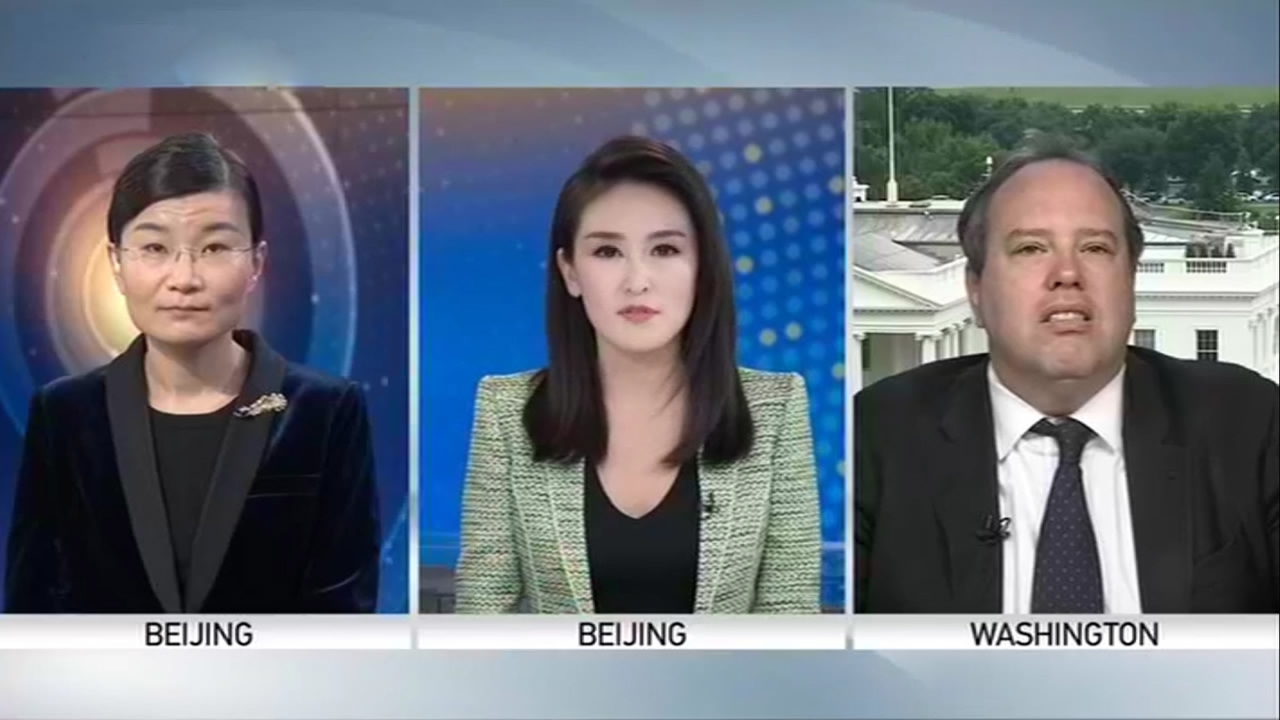
Ralph Winnie Jr. Speaks on CGTN regarding Chinese Economic Policy
Chinese Influence: What's beyond trade for China?
2017-10-24
China has long been an active participant in
global trade. But is the country's impact on the world no more than just
economic? Jim Spellman reports from Washington.
In recent years China's impact on the world has steadily grown.
Xi
Jinping General Secretary of Communist Party of China "The Party has
united and led all the Chinese people in a tireless struggle, propelling
China into a leading position in terms of economic and technological
strength, defense capabilities, and collective national strength.
China's international standing has risen as never before."
Many
experts say China's approach to economic investment is transforming the
world economy. Ralph Winnie leads the China Center at the Eurasia
Institute, a U.S. based think tank.
Ralph
Winnie Jr. Eurasia Institute "China's policy has been we don't
interfere in the internal affairs of other countries. What we want to do
when we go in is create a win-win situation, a trusted partnership
based on economic trade and opportunity to improve the quality of life
for people.
This
non-confrontational approach to foreign direct investment has been
warmly welcomed in many nations, especially in the developing world.
Hussein
Ismail Egyptian Information Agency "General Secretary Xi Jinping
stressed in his report that 'China will not close its door to the world;
it will only become more and more open.' It means foreign corporations
and investors will have more opportunities to enter the Chinese market."
China's
impact isn't simply about trade. As China takes the lead in areas such
as the climate change, more people have become curious about the
country. Tourism and people-to-people exchanges have increased and more
countries see China in a positive way.
Nicholas
Beale Global Collaboration on Financial System Stability "GDP numbers
by themselves don't tell the whole story. GDP growth at the expense of
the environment, for example, is something which perhaps has happened in
the past in China. I am very encouraged to see that, as I understand
it, a very important part of Xi Jinping's vision, that he wants to
advance China in all dimensions - economic, social, environmental,
ethical, etc."
China's rising
prominence has come as the U.S., under President Donald Trump, has
seemed to pull back from the world stage, while pursing protectionist
economic policies.
Ralph Winnie
Jr. Eurasia Institute "The question for the United States is what is our
role going to be? Are we going to treat them as a trusted frind of
partner or are we going to view them as potential adversaries?"
JIM
SPELLMAN WASHINGTON According to a recent Pew Research Center survey
more people now have more confidence in Xi Jinping than in Donald Trump
when it comes to doing the right thing, regarding world affairs. Jim
Spellman, CGTN, Washington.
Copyright
©
2017
China Solution-Ralph Winnie, Jr. commentary on China 24-CGTN regarding global governance and International diplomacy
'China Solution': Experts on global governance
By Xie Mingqi
CGTN invited Su Xiaohui, Deputy Director of
Department of International and Strategic Studies at China Institute of
International Studies, and Ralph Winnie, Director of Global Business
Development and the Eurasian Business Coalition's China Program to
discuss on "China solutions".
Su said China dramatically changed its stance on participating in global governance.
She
added that five or six years ago, the country considered itself not
ready for engagement with a whole series of global issues, but now the
country decides to broadly engage in the worldly affairs, especially in
promoting globalization and climate change.
China is now seeking win-win cooperation with other parts of the world, Su pointed out.
On the other hand, Ralph Winnie said, China has always been pragmatic in its relationship with other countries.
Winnie
claimed the Belt and Road initiative is a typical example of China
solution: it focuses on promoting shared objectives and economic
development.
He also said that China, a responsible stakeholder, greatly helped the regions along the Belt and Road grow.
Wednesday, September 27, 2017
Friday, September 8, 2017
Sputnik News interview of Ralph Winnie, Jr-Russian Sanction-September 2017
04:12 01.08.2017 ©
REUTERS/ Maxim Shemetov
WASHINGTON (Sputnik) — Six days after the House approved an anti-Russian sanctions package on July 24, Russian President Vladimir Putin announced on Sunday that the diplomatic presence of the United States in Russia would be cut by 755 people to 455, the same number of diplomatic personnel that Russia currently has in the US.
On Monday, Vice President Mike Pence said Trump will soon sign into law the new legislation that enhances US sanctions against Russia. It passed by overwhelming majorities of 419 to 3 in the House of Representatives and by 98 to two in the Senate.
RUSSIA’S LEGITIMATE GRIEVANCES
The diplomatic climate between the two thermonuclear superpowers was likely to deteriorate further, Eurasian Business Coalition Vice President Ralph Winnie warned in an interview.
The bill also states that it is the US policy to secure Ukrainian energy dependence, to promote a non-Russian energy sources throughout Western Europe, and forces the National Security Council to include the Secretary of the Treasury.
Russia Diplomatic Cuts, Trump Signing Sanctions May Spark 'Cycle of Retaliation'
Russia’s decision to cut US diplomatic staff was based on legitimate grievances but it risks sparking retaliation while President Donald Trump is set to exacerbate the crisis by signing the very sanctions package that enrages Moscow, analysts told Sputnik.WASHINGTON (Sputnik) — Six days after the House approved an anti-Russian sanctions package on July 24, Russian President Vladimir Putin announced on Sunday that the diplomatic presence of the United States in Russia would be cut by 755 people to 455, the same number of diplomatic personnel that Russia currently has in the US.
On Monday, Vice President Mike Pence said Trump will soon sign into law the new legislation that enhances US sanctions against Russia. It passed by overwhelming majorities of 419 to 3 in the House of Representatives and by 98 to two in the Senate.
RUSSIA’S LEGITIMATE GRIEVANCES
The diplomatic climate between the two thermonuclear superpowers was likely to deteriorate further, Eurasian Business Coalition Vice President Ralph Winnie warned in an interview.
"I was not surprised Russia would retaliate in this fashion," he said.
Moscow had been angered by the repeated accusations from US
politicians and media that Russia had allegedly intervened to try and
influence the 2016 presidential election, Winnie recalled.
"They have been very vocal about how they feel
that they have been singled out unfairly over sanctions by Congress and
by the allegation that they intervened in the US election," he said.
Trump still had a window of opportunity to avoid a further
deterioration in relations with Moscow if he defied congressional
pressure and refused to sign the sanctions legislation, Winnie stated.
"A lot depends on what Trump does next," he said.
However, if Trump goes ahead and signs the bill, as Pence has said he
will, then Russia could be expected to take other retaliatory measures,
angering US hawks even more, Winnie warned.
"If Trump signs the bill, it is likely that there will be more consequences," he said.
Jon Huntsman, Trump’s choice as next US ambassador to Moscow has held
high level diplomatic positions and also has had extensive experience
of doing business with Russia, but he will need all of his tact and
skill to try and retain and repair good relations between the two
governments, Winnie cautioned.
"Huntsman will have his work cut out to smooth out relations between the United States and Russia," he said.
RISKS OF COUNTER-MEASURES
Author and political activist David Swanson suggested that the Moscow government
had ordered the cuts in US diplomatic personnel out of increasing anger
at the escalating barrage of accusation and hostile measures from the US
legislature and government, regardless of Russian peace efforts.
"President Putin said he was frustrated and
losing patience. He also characterized US sanctions as being — like US
war making and war threats — violations of law," Swanson said.
Swanson said the US government needed to be held accountable for its
activities in countries ranging from Syria and Libya to Ukraine in an
international court of law.
"I wish that Russia and the world would,
with the help of responsible US residents, pursue the application of law
to US aggression through the World Court and the ICC [International
Criminal Court]," he said.
Washington and Moscow risked getting caught up in a negative cycle
of diplomatic and economic measures and retaliation, Swanson cautioned.
"Countermeasures are understandable but do indeed risk a cycle of escalation," he advised.
However, the ultimate target of US policy could turn out to be not Russia but Iran, Swanson warned.
"I think we all are in danger of losing focus
on the likelihood that the primary victim of the latest sanctions and
threats may turn out to be Iran, and all of this may be a prelude to the
all-out destruction of that country," he concluded.
The new US legislation imposed additional sanctions on Iran and North Korea as well as on Russia.The bill also states that it is the US policy to secure Ukrainian energy dependence, to promote a non-Russian energy sources throughout Western Europe, and forces the National Security Council to include the Secretary of the Treasury.
Tuesday, August 8, 2017
Summary of Remarks of Ralph Winnie, Jr. at DACOR-August 2017
Mr. Ralph Winnie and Mr. William Yale
The State of U.S.-China Relations
Wednesday, August 2nd, 2017
Author: William Mallard
(Audio + Talk)
Ralph Winnie is a partner of Henson, Pang and Winnie, a premier international law firm and consulting group with offices in Washington, D.C. in the United States and Shanghai in China. He also serves as Director of the China Program for the Eurasia Center and its Eurasian Business Coalition, an organization dedicated to promoting and preserving the ideas of affordable housing, economic cooperation, environmental sustainable development and the promotion of business development, tax and trade between the United States and the fifty-nine nations comprising Eurasia. Mr. Winnie has extensive experience in international affairs, international business development and trade, and domestic and international tax policies. Mr. Winnie has held many prominent positions including most recently: Director of the China Program for the Eurasia Center; Vice-President of Global Business Development for the Eurasian Business Coalition; and countless board positions for international organizations. William Yale is an Adjunct Fellow at the American Security Project and a Research Associate at the SAIS Foreign Policy Institute (FPI). He has previously worked at the U.S. Naval War College and the State Department.
Mr. Winnie and Mr. Yale came to the DACOR Bacon House to hold an Q&A session concerning the subject of the general state of U.S.-Chinese relations and included issues such as the South China Sea, North Korea, and the Trump administration. Mr. Yale’s first question was on Mr. Winnie’s views concerning the Trump administration’s impact on the U.S.-China relationship. Mr. Winnie responded stating that President Trump’s views of China have been characterized by strong language but that his focus has been on developing bilateral relationships and negotiations, as opposed to the strong focus on multilateral deals and relationships from previous administrations. Hence the U.S.’ removal of itself from the Trans-Pacific Partnership, which President Trump viewed as detrimental to the U.S. Despite the consistent amount of goodwill still in Asia towards the U.S., Mr. Winnie stated that the Trump administration’s words and actions could erode said goodwill. Thus, while initial U.S.-China relations haven’t deteriorated overmuch, China is having to reexamine its relationship strategy and is therefore looking to expand its relationships and alliances with other entities such as the EU.
Mr. Yale then switched subjects and asked whether there were any levers through which the U.S. and China could work together towards a solution concerning North Korea. Mr. Winnie responded by stating that some possible solutions for the U.S. are that it could penalize the Chinese banks that are connected to various Chinese front companies that smuggle goods to North Korea. As well, the U.S. has several issues through which it can influence China such as Taiwan, the islands in the South China Sea, and issues concerning the Chinese-Indian border. The discussion then examined ways in which the U.S. can respond to China’s human rights record. Mr. Winnie then explained that the U.S., while it should be confident in its projection of its soft power abroad and should work to promote democracy and freedom within China, must maintain a sense of wariness and caution, since the Chinese don’t want to bow to foreign interference in their domestic affairs.
The discussion then changed gears and focused on the South China Sea. Mr. Winnie reviewed the U.S.’ interests in the South China Sea and emphasized differing scenarios based upon the U.S.’ strategy in the
region. As an illustration, if the U.S. wishes to maintain its status as the global hegemon, it must be committed to maintaining large numbers of military forces in the region to dissuade China’s military advances and reassure America’s regional allies. If not, Mr. Winnie stated that the U.S. should commit to no more than ensuring access to free seas for maritime trade and should sit back and let China continue to develop and rise in power. Mr. Winnie did state further that the U.S. had too many interests in the region to affect a pullback and could not afford to resign its commission as the global hegemon, which would necessitate increased military cooperation with its regional allies to hedge against a swiftly rising China.
Mr. Yale followed up with a question concerning the new U.S. ambassador to China and his thoughts on the perceived effectiveness of the new diplomat, to which Mr. Winnie responded by stating that the ambassador was a good pick with extensive knowledge and experience of Chinese relations and culture. Mr. Winnie went further, stating that this new ambassador has a long-standing commitment to the principles of free trade and will be able to foster long-term relationships with the Chinese government. As well, Mr. Winnie believes that the new Secretary of State will be able to use his experience leading a large, multinational corporation to forge strong ties with the Chinese leadership. Finally, Mr. Yale asked Mr. Winnie about his opinions concerning China’s upcoming Party Congress in the Fall, to which Mr. Winnie replied that China’s top leader, Xi Jingping, is the most powerful and influential leader that China has seen in decades and will most likely continue to solidify his power when the Chinese government next convenes.
Mr. Winnie and Mr. Yale then concluded the initial portion of their discussion by taking questions from the audience. One question concerned Mr. Winnie’s perspective on the perceived ties between President Putin and Xi Jingping, to which he replied that, while the two leaders both respect each other and have forged closer ties, the Russian and Chinese peoples don’t hold each other in very high esteem, making their partnership one built on shaky foundations. As well, Mr. Winnie spoke on China’s use of its soft power, particularly through its cultivation of the One Belt, One Road initiative. He sated his belief that the global banking system needs to be liberalized and that the U.S. must continue to cultivate relationships with other Asian states. Mr. Winnie concluded the discussion with a brief set of remarks concerning President Trump’s foreign policy. He stated that Mr. Trump approaches his foreign-policy decision-making from the perspective of a business-man focused on bilateral business deals. Thus, the expectations of Mr. trump to become a diplomat are largely unfounded as he will continue to conduct deals on a case-by-case basis like the businessman that he in fact is.
The State of U.S.-China Relations
Wednesday, August 2nd, 2017
Author: William Mallard
(Audio + Talk)
Ralph Winnie is a partner of Henson, Pang and Winnie, a premier international law firm and consulting group with offices in Washington, D.C. in the United States and Shanghai in China. He also serves as Director of the China Program for the Eurasia Center and its Eurasian Business Coalition, an organization dedicated to promoting and preserving the ideas of affordable housing, economic cooperation, environmental sustainable development and the promotion of business development, tax and trade between the United States and the fifty-nine nations comprising Eurasia. Mr. Winnie has extensive experience in international affairs, international business development and trade, and domestic and international tax policies. Mr. Winnie has held many prominent positions including most recently: Director of the China Program for the Eurasia Center; Vice-President of Global Business Development for the Eurasian Business Coalition; and countless board positions for international organizations. William Yale is an Adjunct Fellow at the American Security Project and a Research Associate at the SAIS Foreign Policy Institute (FPI). He has previously worked at the U.S. Naval War College and the State Department.
Mr. Winnie and Mr. Yale came to the DACOR Bacon House to hold an Q&A session concerning the subject of the general state of U.S.-Chinese relations and included issues such as the South China Sea, North Korea, and the Trump administration. Mr. Yale’s first question was on Mr. Winnie’s views concerning the Trump administration’s impact on the U.S.-China relationship. Mr. Winnie responded stating that President Trump’s views of China have been characterized by strong language but that his focus has been on developing bilateral relationships and negotiations, as opposed to the strong focus on multilateral deals and relationships from previous administrations. Hence the U.S.’ removal of itself from the Trans-Pacific Partnership, which President Trump viewed as detrimental to the U.S. Despite the consistent amount of goodwill still in Asia towards the U.S., Mr. Winnie stated that the Trump administration’s words and actions could erode said goodwill. Thus, while initial U.S.-China relations haven’t deteriorated overmuch, China is having to reexamine its relationship strategy and is therefore looking to expand its relationships and alliances with other entities such as the EU.
Mr. Yale then switched subjects and asked whether there were any levers through which the U.S. and China could work together towards a solution concerning North Korea. Mr. Winnie responded by stating that some possible solutions for the U.S. are that it could penalize the Chinese banks that are connected to various Chinese front companies that smuggle goods to North Korea. As well, the U.S. has several issues through which it can influence China such as Taiwan, the islands in the South China Sea, and issues concerning the Chinese-Indian border. The discussion then examined ways in which the U.S. can respond to China’s human rights record. Mr. Winnie then explained that the U.S., while it should be confident in its projection of its soft power abroad and should work to promote democracy and freedom within China, must maintain a sense of wariness and caution, since the Chinese don’t want to bow to foreign interference in their domestic affairs.
The discussion then changed gears and focused on the South China Sea. Mr. Winnie reviewed the U.S.’ interests in the South China Sea and emphasized differing scenarios based upon the U.S.’ strategy in the
region. As an illustration, if the U.S. wishes to maintain its status as the global hegemon, it must be committed to maintaining large numbers of military forces in the region to dissuade China’s military advances and reassure America’s regional allies. If not, Mr. Winnie stated that the U.S. should commit to no more than ensuring access to free seas for maritime trade and should sit back and let China continue to develop and rise in power. Mr. Winnie did state further that the U.S. had too many interests in the region to affect a pullback and could not afford to resign its commission as the global hegemon, which would necessitate increased military cooperation with its regional allies to hedge against a swiftly rising China.
Mr. Yale followed up with a question concerning the new U.S. ambassador to China and his thoughts on the perceived effectiveness of the new diplomat, to which Mr. Winnie responded by stating that the ambassador was a good pick with extensive knowledge and experience of Chinese relations and culture. Mr. Winnie went further, stating that this new ambassador has a long-standing commitment to the principles of free trade and will be able to foster long-term relationships with the Chinese government. As well, Mr. Winnie believes that the new Secretary of State will be able to use his experience leading a large, multinational corporation to forge strong ties with the Chinese leadership. Finally, Mr. Yale asked Mr. Winnie about his opinions concerning China’s upcoming Party Congress in the Fall, to which Mr. Winnie replied that China’s top leader, Xi Jingping, is the most powerful and influential leader that China has seen in decades and will most likely continue to solidify his power when the Chinese government next convenes.
Mr. Winnie and Mr. Yale then concluded the initial portion of their discussion by taking questions from the audience. One question concerned Mr. Winnie’s perspective on the perceived ties between President Putin and Xi Jingping, to which he replied that, while the two leaders both respect each other and have forged closer ties, the Russian and Chinese peoples don’t hold each other in very high esteem, making their partnership one built on shaky foundations. As well, Mr. Winnie spoke on China’s use of its soft power, particularly through its cultivation of the One Belt, One Road initiative. He sated his belief that the global banking system needs to be liberalized and that the U.S. must continue to cultivate relationships with other Asian states. Mr. Winnie concluded the discussion with a brief set of remarks concerning President Trump’s foreign policy. He stated that Mr. Trump approaches his foreign-policy decision-making from the perspective of a business-man focused on bilateral business deals. Thus, the expectations of Mr. trump to become a diplomat are largely unfounded as he will continue to conduct deals on a case-by-case basis like the businessman that he in fact is.
Wednesday, August 2, 2017
Saturday, July 22, 2017
Ralph Winnie, Jr. quoted in Sputnik News-Significance of Huntsman's appointment as next US ambassador to Moscow
Huntsman Expected to Bring Bipartisan Support to Post as Ambassador to Russia
New US Ambassador to Russia Jon Huntsman has worked for both Republican and Democratic presidents and won the respect and trust of legislators from both parties in Congress so is expected to bring a non-ideological approach to the position, analysts told Sputnik.
WASHINGTON (Sputnik) — The White House announced Huntsman’s appointment on Wednesday, even though he had previously sharply criticized Trump during the 2016 presidential campaign. He has also helped lead a family chemicals company that conducts business in Russia
HUNTSMAN’S RECORD COMMANDS RESPECT AMONG US POLITICIANSHuntsman has served in every US presidential administration since Ronald Reagan in the early 1980s and was CEO of his family-owned Huntsman Corporation.
"Huntsman is very credible choice for the
post," Eurasian Business Coalition Vice President Ralph Winnie told
Sputnik on Friday. "He has mutual respect on both sides of the aisle."
Huntsman served as a White House staff assistant for Reagan then
became Deputy Assistant Secretary of Commerce and US Ambassador
to Singapore under Reagan’s Republican successor President George H.W.
Bush.In a career of national prominence lasting more than three and a half decades, Huntsman had compiled a spotless record of personal trust and integrity, Winnie stated.
"No scandals and very knowledgeable about international affairs," he said
Huntsman’s record included negotiating China’s entry into the World
Trade Organization (WTO) in 2001 and serving as President Barack Obama’s
ambassador to Beijing, Winnie recalled.Huntsman is a Republican moderate and pragmatist who will work hard to develop good relations between Washington and Moscow, Winnie explained.
"He has the ability to negotiate effectively," he said.
HUNTSMAN BUSINESS EXPERIENCE SEEN AS POSITIVE FACTOR
Like Secretary of State Rex Tillerson, the longtime former Chairman and CEO of Exxon Mobil, Huntsman already had experience of doing business in Russia before his latest appointment.
Former Brown University Assistant Professor of Economics Barry Friedman agreed that Huntsman’s extensive business background was likely to be a major advantage for his effectiveness as ambassador to Moscow.
"Is it so unusual to have a business leader
appointed as an Ambassador? I think not, and he has already served
in that capacity," he said.
Friedman explained that independent wealth often meant a diplomat was
more independent and secure and less likely to be swayed by issues
of personal profit in his professional duties.
"You don't want someone of modest means and hungry who would perhaps be even more vulnerable to influence," he said.
Allegations that Huntsman might face conflict of issues criticism
because of his previous business dealings in Russia did not appear to be
a serious problem for his confirmation by the Senate, Friedman noted.
"I don't know if you can ever 100 percent prove
the absence of a conflict of interest. You could have assets put in a
blind trust, but informal understandings might be reached that reward a
person later," he remarked.
While Huntsman was expected to play a constructive role in setting a
positive tone in personal diplomacy with Russian officials, the
structure of the US government meant he was not likely to be a decisive
figure in setting policy toward the Kremlin, Freidman cautioned.
"The Ambassador does not usually make policy
between countries: More likely an Ambassador would not have the
resources of the National Security Council and the Secretaries of State
and Defense when it comes to critical information to advise the
President," he noted.
US ambassadors had made a much greater difference in shaping policies
towards major powers decades ago before the vast expansion of the
National Security Council’s centralizing bureaucracy and the State
Department’s increasing micro-management of diplomatic activities,
Friedman recalled.
"Maybe Averill Harriman [US ambassador to the
United Kingdom and the Soviet Union during World War II] But Ambassadors
making a critical difference in shaping policies? Increasingly rare,"
he said
However, Huntsman’s extensive diplomatic and business experience
meant he was likely to already enjoy an extended circle of friends and
contacts in Moscow that could make him far more effective as a
bridge-builder between the two governments, Friedman pointed out."To convey useful information it would help to build up some trustworthy high-level connections so the fact that he has had some business operations in Russia before may even be a plus," he suggested.
Ralph Winnie, Jr. quoted in Sputnik News-Significance of Huntsman's appointment as next US Ambassador to Moscow

Huntsman Expected to Bring Bipartisan Support to Post as Ambassador to Russia
©
AP Photo/ Matt Rourke
New
US Ambassador to Russia Jon Huntsman has worked for both Republican and
Democratic presidents and won the respect and trust of legislators from
both parties in Congress so is expected to bring a non-ideological
approach to the position, analysts told Sputnik.

©
AFP 2017/ PAUL J. RICHARDS
Huntsman has served in every US presidential administration since Ronald Reagan in the early 1980s and was CEO of his family-owned Huntsman Corporation.
"Huntsman is very credible choice for the
post," Eurasian Business Coalition Vice President Ralph Winnie told
Sputnik on Friday. "He has mutual respect on both sides of the aisle."
Huntsman served as a White House staff assistant for Reagan then
became Deputy Assistant Secretary of Commerce and US Ambassador
to Singapore under Reagan’s Republican successor President George H.W.
Bush.In a career of national prominence lasting more than three and a half decades, Huntsman had compiled a spotless record of personal trust and integrity, Winnie stated.
"No scandals and very knowledgeable about international affairs," he said
Huntsman’s record included negotiating China’s entry into the World
Trade Organization (WTO) in 2001 and serving as President Barack Obama’s
ambassador to Beijing, Winnie recalled.Huntsman is a Republican moderate and pragmatist who will work hard to develop good relations between Washington and Moscow, Winnie explained.
"He has the ability to negotiate effectively," he said.
HUNTSMAN BUSINESS EXPERIENCE SEEN AS POSITIVE FACTOR
©
AP Photo/ Matt Rourke
"Is it so unusual to have a business leader
appointed as an Ambassador? I think not, and he has already served
in that capacity," he said.
Friedman explained that independent wealth often meant a diplomat was
more independent and secure and less likely to be swayed by issues
of personal profit in his professional duties.
"You don't want someone of modest means and hungry who would perhaps be even more vulnerable to influence," he said.
Allegations that Huntsman might face conflict of issues criticism
because of his previous business dealings in Russia did not appear to be
a serious problem for his confirmation by the Senate, Friedman noted.
"I don't know if you can ever 100 percent prove
the absence of a conflict of interest. You could have assets put in a
blind trust, but informal understandings might be reached that reward a
person later," he remarked.
While Huntsman was expected to play a constructive role in setting a
positive tone in personal diplomacy with Russian officials, the
structure of the US government meant he was not likely to be a decisive
figure in setting policy toward the Kremlin, Freidman cautioned.
"The Ambassador does not usually make policy
between countries: More likely an Ambassador would not have the
resources of the National Security Council and the Secretaries of State
and Defense when it comes to critical information to advise the
President," he noted.
US ambassadors had made a much greater difference in shaping policies
towards major powers decades ago before the vast expansion of the
National Security Council’s centralizing bureaucracy and the State
Department’s increasing micro-management of diplomatic activities,
Friedman recalled.
"Maybe Averill Harriman [US ambassador to the
United Kingdom and the Soviet Union during World War II] But Ambassadors
making a critical difference in shaping policies? Increasingly rare,"
he said
However, Huntsman’s extensive diplomatic and business experience
meant he was likely to already enjoy an extended circle of friends and
contacts in Moscow that could make him far more effective as a
bridge-builder between the two governments, Friedman pointed out."To convey useful information it would help to build up some trustworthy high-level connections so the fact that he has had some business operations in Russia before may even be a plus," he suggested.
Wednesday, July 12, 2017
Subscribe to:
Posts (Atom)