
Ralph Winnie Jr. with the Mongolian President

Monday, August 15, 2011


Wednesday, June 15, 2011


Monday, June 13, 2011

Wednesday, June 8, 2011
Pictures of Ralph Winnie, Jr. with Ambassador Christian Prosl, Mahtab Farid of Voice of America and Hugh Grindstaff of THIS from the Austrian Embassy
Here are two pictuers of Ralph Winnie Jr., Ambassador Christian Prosl of
Austria, Mahtab Farid and Hugh Grindstaff at the Embasssy of Austria.


Austria, Mahtab Farid and Hugh Grindstaff at the Embasssy of Austria.


Wednesday, June 1, 2011
Ralph Winnie Jr., Contributing Editor's Article on G8 in Deauville France May 2011
Traditionally, French diplomacy has been dominated by almost exclusive representation of the French aristocracy who controlled the selection and promotion processes of French diplomatic service. It is interesting to note that rising up through this system was Jean David Levitte, currently the top advisor to President Nicolas Sarkozy, who became the first foreign born president of the French Republic. Jean David Levitte was encouraged to carefully conceal his religious identity (Jewish) in order to advance his career in international diplomacy. There appears to be a new variant emerging in French diplomacy, encompassing strong moral and ethical values, especially obvious in the French diplomatic reaction to the new Arab revolutions occurring in Egypt and Tunisia as well as the moral implications associated with France’s strong international advances in the Libyan conflict. This is in direct contrast to the principles of pure national “self-interest” which had dominated French diplomatic thought and policy, focusing on the access to and the exploitation of foreign national resources and continuing as an international power broker in the management of nuclear proliferation.
During my time at the G8, it became apparent that the salient issues of concern to the French, which will continue to be addressed at the G20 Summit later this year, were international nuclear safety issues, the Arab Spring, policy recommendations regarding the Internet, partnership with Africa and international peace and security, focusing on the situation in Libya and Syria as well as the resumption of the Middle East peace process.
At the summit in Deauville, the G8 member countries expressed strong support and solidarity with Japan in the aftermath of the Fukushima disaster. The objectives proposed by the G8 members to address growing concerns by the international community over how to address safety standards related to the construction and operation of nuclear power reactors involved:
- Comprehensive assessment by the French of the safety of existing nuclear facilities and urging all G8 member countries to follow suit.
- Strengthening co-operation internationally which necessitates involving governmental authorities, regulatory, research and industrial bodies in an effort to develop a culture of accountability, safety and transparency.
- Promoting the role of the International Atomic Energy Agency (IAEA) and international nuclear conventions along with improving the crisis management system.
- Encouraging all countries who develop nuclear energy to have infrastructure in place for development of their programs consistent with IAEA recommendations.
Consequently, Russia, in an effort to use its well-established nuclear industry to extend its global influence offered a more stringent proposal regarding international nuclear safety issues. Russia, the country with the smallest economy in the G8, a “junior partner in financial terms”, set forth a proposal to strengthen safety standards governed by the IAEA and make binding mandatory international safety rules subject to strict verification and compliance. While the G8 member countries had expressed interest in Russia’s proposal, which will be evaluated moving forward to the G20, France recognizes that advocating compulsory requirements and forcing countries to give up their sovereignty involving nuclear safety inspection will make countries very leery of binding verification.
At the G8, member countries promised $20 billion in aid to Tunisia and Egypt and held out the prospect of billions more to foster the Arab Spring and continue to assist the emerging democracies evolving from the popular uprisings. Sarkozy, invited the prime ministers of Egypt and Tunisia on May 27, 2011 to launch the Deauville Partnership with Egypt and Tunisia as they embark on democratic reform. The members of the G8 strongly support the aspirations of the Arab Spring as well as those of the Iranian people who are still struggling against an oppressive regime. The Deauville Partnership was created to support the economic and social reforms designed to “enshrine common values of freedom and democracy”. This Partnership is based on two fundamental principles. There is a political process designed to support the democratic transition and foster governance reforms, such as the fight against corruption and the strengthening of the institutions needed to ensure transparency and accountable government. There is also an economic framework for sustainable and inclusive growth. The Declaration is designed to support countries like Egypt and Tunisia in the economic and social reforms they will undertake in an effort to create jobs and follow the rule of law while, at the same time, ensuring economic stability during the transition to a stable democracy. International financial institutions, UN Agencies, the private sector and civil society were actively encouraged, moving forward to the G20, to work with the Deauville Partnership.
During my discussions with the spokesman for the Prime Minister of Tunisia, I tried to assess the role that China would play in the Deauville Partnership, moving forward to the G20. While China’s absence at the G8 prevented the spokesman from going into specifics, he openly discussed the close personal ties between Tunisia, Egypt and China and fully expects strong bilateral communications with Beijing in the very near future.
The EG8 summit, which had just recently concluded in Paris prior to the G8, was designed to create policy recommendations that the delegation of six technology chief executives, including Erick Schmidt of Google and Mark Zuckerberg of Facebook, would present to the world leaders in Deauville. This was designed to find ways to regulate the Internet that would be acceptable to both governments and industry. In Deauville, for the first time at the Leaders’ level, G8 member countries, moving forward to the G20, agreed in the presence of Eric Schmidt and Mark Zuckerberg, on several key principles. These principles included “freedom, respect for privacy, multi-stakeholder governance, cyber-security and protection from crime that underpin a strong and flourishing Internet.” The global CEOs who had been invited to attend the G8 strongly supported reviewing and analyzing these issues moving forward to ensure a safe and secure Internet.
In Deauville, G8 member countries renewed a strong partnership with Africa, building on commitments made over the last 10-20 years. There is strong belief among G8 member countries that Africa today is an emerging continent containing abundant natural resources with economic growth averaging 5%. In fact, the leaders of Algeria, Egypt, Nigeria and South Africa have been associated with the G8 for the past several summits as founding members of the New Partnership for Africa’s Development in an effort to forge working relationships with African states and G8 members countries. The G8 member countries emphasized mutual responsibilities and decided to be even more accountable regarding “commitments to development, peace and security.” Transparency and governance were also emphasized and the G8 member countries “welcomed the new dynamism of our African partners and the spread of democracy and committed to stand even more strongly side by side with people of the African countries.” At the G8, recognition was given to the democratically elected Presidents of Cote D’Ivoire, Guinea and Niger. For the first time, G8 member countries adopted a joint declaration “together with African leaders.”
The G8’s commitment to Africa, moving forward, can be seen in its concrete actions.
- The G8 has made “strong contribution to the cancellation of the poor countries’ debt since 1996.
- The G8 created the Global Fund to fight Aids, Tuberculosis, and Malaria in 2001 and has since provided the bulk of funding to supply HIV/AIDS treatment.
- In 2004, the G8 trained roughly 75,000 African troops for peacekeeping and security missions, mainly concentrated in Africa.
- The G8 provides a considerable share of bilateral official development assistance (ODA) to Africa (36% on average).
France is the number one G8 country in terms of the concentration of its aid in Africa. In 2010, 54% of its ODA was earmarked for the African continent. (4.2 billion)
The G8 member countries, including very comprehensive statements made by Prime Minister David Cameron of the United Kingdom and President Nicholas Sarkozy of the French Republic, emphasized that they would continue to act in support of peace and international security. The G8 became a forum for member countries to demand the immediate cessation of the use of force against civilians by the Libyan regime (Gaddafi) and support a political solution that “reflects the will of the Libyan people.” Both Cameron and Sarkozy support the continued and escalating presence in Libya as both leaders feel their respective countries have a moral obligation to stop a ruthless dictator and protect innocent lives.
The G8 member countries, at the urging of President Sarkozy, called on the Syrian government to stop using force and intimidation against the Syrian people and to engage in dialogue and broad reforms in response to the legitimate demands and desires of the Syrian people. It was further mentioned that the demand for change and reform clearly articulated by Arab intellectuals and young people is historic and makes the solution to the Israeli-Palestinian conflict paramount. At the G8, both the Israelis and the Palestinians were encouraged to engage without delay “in substantive talks with a view to concluding a framework agreement on all final status issues.” At the G8, President Sarkozy reacted very favorably to Obama’s speech and his vision towards the Middle East in an effort to relaunch talks between Israel and the Palestinians and support the 1967 boundaries as per the UN resolution. Obama’s position aligns very closely with France.
Finally, during the G8, there was a constant buzz about Christine Lagarde’s candidacy as head of the IMF to succeed Dominique Strauss-Kahn. Both Prime Minister Cameron and President Sarkozy avoided any public endorsement of Lagarde’s candidacy, but sources close to the Diplomatic Courier at the G8 indicated that both of these leaders supported Lagarde’s candidacy, given her solid legal and financial background as well as the fact that she is European and would follow the normal progression of a European assuming the head of the IMF while an American heads the World Bank. This mindset has not found favor with countries like Brazil and South Africa who feel developing countries should have a greater role and voice in the G8 and now are actively opposing her candidacy.
However, Lagarde appears to have enough support in China, Europe and the United States to handily defeat any potential challenges to head the IMF. She is considered to be familiar with all of the substantive issues and is a great negotiator with good political instincts. As was discussed at the G8, the main obstacle to Lagarde’s nomination could be a possible judicial probe into her role in awarding a friend of President Sarkozy a 285 million Euro payout to settle a legal dispute. While Sarkozy has no problem with Lagarde being put under the microscope regarding her handling of this affair, my sources at the G8 indicated that Lagarde’s effectiveness as head of the IMF could depend on the manner in which this situation is resolved. Any sense of a backroom deal between the U.S. and Europe to choose Lagarde could leave some bad feeling that would undermine her. My sources indicate this would be true even though she has the backing of China, moving forward to the G20, which appreciated her handling of a controversy over the yuan’s exchange rate at prior G20 meetings.
Consequently, while Strauss-Kahn’s economic expertise was an asset during the global credit crisis of 2007-2009 and he was instrumental in putting together a comprehensive aid package to bail out Greece, Lagarde does not have a career path as an economist or civil servant at a national bank or finance ministry. My sources advise me that Lagarde would oppose bailing out Greece due to the increased costs of such a bailout to other European countries, yet she has not put forth any plan to deal with Greece’s inevitable default. Such an issue left unresolved through the G20 would compromise Lagarde’s credibility and that of the G8 as the G8 continues to play a significant role in the international global economy.
Thursday, May 12, 2011
Ralph Winnie Jr., Contributing Editor's Article "US travel industry calls for more visas for Chinese" in CCTV
http://english.cntv.cn/program/china24/20111205/106852.shtml
Political leaders in Washington are under pressure to simplify and speed up the visa process for Chinese people seeking to visit the United States. The calls from the US travel industry and from US-China business advocates come just as Congress moves forward with a new law to increase immigration quotas for highly skilled workers in places like China. But as our Washington Correspondent Daniel Ryntjes reports, there are growing calls for even more comprehensive reform of a system that has proved frustratingly slow for many potential Chinese travelers and immigrants.
In a rare and overwhelmingly positive vote of 389 for and 15 against, the House of Representatives has agreed to raise the immigrant quotas for highly skilled individuals, to the benefit of individuals in larger countries like China. The US Senate is also expected to approve the idea.
China Immigration expert Ted Gong said: "That bill changes the per-country limit, so that instead of 7% per country, you can increase it by 15%. That means then that countries like India and China which are very backlogged, they can get more people to come to the United States more quickly."
The backlog for applicants is partly the result of raised security requirements following the attacks of September 11th 2001, which has adversely impacted the US travel industry.
Spokesperson for US Travel Association Robert Bobo said: "Chinese travelers, but everyone else in the entire world now, after 9/11, has to undergo a personal interview with a US embassy or consulate staffer. And so that means that there are more people that are needing to be seen by these visa processing centers, consulates, embassies, but we don’t meet the demand with enough staff or with enough resources."
The US State Department has increased the number of staff in China to handle these interviews after a 123% rise in the number of non-immigrant visa applications in the last 5 years. They’ve been working on about 1 million adjudications in China this year alone.
Bobo said: "If we could implement a better visa policy then we would see an increase in the amount of travel to the United States which could possibly add about $850 billion to our economy and increase jobs by 1.3 million."
On the immigration side, some Chinese people are taking advantage of a program in which they can qualify to settle in the US if they invest at least $1 million or just $500,000 into designated high unemployment areas.
Ralph Winnie Jr, China Program director in Eurasia Center, said: "There are a lot of success stories of US and Chinese companies that have been able to partner together. And that really needs to be the focus and we really need to make it easier to streamline the visa process."
US travel companies have also calculated that Chinese visitors spend about one third more when they come to the United States than the average.
Reporter: “This presents a significant incentive for the US to consider not just improvements but also reforms to its complex visa and immigration systems.”
Wednesday, April 27, 2011

Tuesday, April 26, 2011


Wednesday, February 9, 2011

Friday, January 21, 2011
Sunday, November 21, 2010
Ralph Winnie Jr., Contributing Editor's Article "Closer to China" in the Washington Post
http://www.divshare.com/download/18563679-719
During President Barack Obama’s recent trip to the People’s Republic of China, he strongly
urged China to strengthen its currency as tensions escalate between the United States and
China over exchange rates. While both President Hu Jintao and President Obama agreed to
work together on pressing international issues, Obama has now joined many world leaders
calling on China to allow its currency, the renminbi, to appreciate. Obama contends that the
currencyis undervalued and damages U.S. exports. The Russian Federation, however, has been
quiet on this matter.
The People’s Republic of China has become a major economic player in the world community.
As China continues to grow, Russia views the situation as more of an opportunity rather than a
threat. China has been successful in actively promoting joint venture partnerships with profitable
Western companies. Currently, Russia lacks the ability to effectively integrate these new
technologies into the fabric of its economy.
The Russian government recognizes that the key to developing a robust and stable economy is
to push strengthening relations with China. Russia is eager to understand how China has been
able to rapidly absorb and utilize Western know-how and entrepreneurial business success;
itseeks to emulate China’s relatively open economy. Privatized Chinese companies can now
work together with Western companies to develop, refine and control capitalism. By contrast,
Russia’s economy has been characterized as unstable, unmanageable and unworkable. This is
due to the interrelation of organized crime with Russian political leaders and nationalization of
successful foreign businesses.
Many members of the Russian politburo have strong ties with oil and natural gas companies
seeking to increase and expand their presence in Asia. Many people associated with these
firms are former high-ranking Russian military officers, including ex-KGB, who were among the
most professionally trained in the former U.S.S.R. These people seek out profitable joint
venture business opportunities, thereby hoping to prevent the United States from dominating
global affairs. According to recent studies, many Russians (47 percent) have responded
favorably to increasing trade contacts and ties with China. Russians view the rise of China as
the result of a more multipolar world. They believe that the United States must learn to coexist
with other rising powers, including China and Russia.
While the Russian government wants to protect and defend Russia’s sovereignty, they
recognize that the Federation may be better protected through closer economic ties with China
rather than the West. Many Russians believe that the Chinese respect a country’s internal
affairs and don’t seek to enforce the ideals of a “good society” on other sovereign nations.
Moreover, President Hu Jintao echoed the Russian sentiment toward U.S. policy when, during
his recent meeting with President Obama in Beijing, Hu mentioned, “We will continue to act in
a spirit of equality, mutual respect and noninterference in each other’s internal affairs.”
It has been suggested that Russia views a close economic, political and strategic relationship
with China as a viable, ongoing relationship that could mature into a political, economic or
military union similar to the North Atlantic Treaty Organization or the now-defunct Warsaw Pact.
In this new union, China, Iran, Russia, Venezuela and many other non-Western nations would
emerge as a powerful bloc in opposition to the imposition by the West of Western-style
capitalism and democracy. This system is still viewed as chaotic, unstable and uncontrollable
by the Russian government and its people, who still vividly remember the collapse of Russia
and its tumultuous transition to a democratic system.
The prospect of China providing a security buffer against Russia has been the rationale for
mistrust and suspicion between China and Russia. However, the leadership in Russia wants to
strengthen Russia’s ability to choose its own partners in an increasingly globalized society. For
the past twenty years, Russia has always sought recognition from the West as a leading
superpower. However, strong criticism of Russia by presidents George W. Bush and Bill Clinton
created a perception that the United States is an arrogant hegemonist. Unlike China, the
prevailing view among the Russian government is that the United States is seeking domination,
manipulation and isolation of Russia.
The closer relationship being established between China and Russia should encourage the
United States to alter its mindset toward Russia. The United States must support the
emergence of a rapidly growing Russian middle class. Encouraging Russia to participate as a
responsible stakeholder in the global community will help Russia choose and manage its
economic and political relationships wisely.
Ralph E. Winnie, Jr., is the Director of the Eurasian Business Coalition’s China Program.
During President Barack Obama’s recent trip to the People’s Republic of China, he strongly
urged China to strengthen its currency as tensions escalate between the United States and
China over exchange rates. While both President Hu Jintao and President Obama agreed to
work together on pressing international issues, Obama has now joined many world leaders
calling on China to allow its currency, the renminbi, to appreciate. Obama contends that the
currencyis undervalued and damages U.S. exports. The Russian Federation, however, has been
quiet on this matter.
The People’s Republic of China has become a major economic player in the world community.
As China continues to grow, Russia views the situation as more of an opportunity rather than a
threat. China has been successful in actively promoting joint venture partnerships with profitable
Western companies. Currently, Russia lacks the ability to effectively integrate these new
technologies into the fabric of its economy.
The Russian government recognizes that the key to developing a robust and stable economy is
to push strengthening relations with China. Russia is eager to understand how China has been
able to rapidly absorb and utilize Western know-how and entrepreneurial business success;
itseeks to emulate China’s relatively open economy. Privatized Chinese companies can now
work together with Western companies to develop, refine and control capitalism. By contrast,
Russia’s economy has been characterized as unstable, unmanageable and unworkable. This is
due to the interrelation of organized crime with Russian political leaders and nationalization of
successful foreign businesses.
Many members of the Russian politburo have strong ties with oil and natural gas companies
seeking to increase and expand their presence in Asia. Many people associated with these
firms are former high-ranking Russian military officers, including ex-KGB, who were among the
most professionally trained in the former U.S.S.R. These people seek out profitable joint
venture business opportunities, thereby hoping to prevent the United States from dominating
global affairs. According to recent studies, many Russians (47 percent) have responded
favorably to increasing trade contacts and ties with China. Russians view the rise of China as
the result of a more multipolar world. They believe that the United States must learn to coexist
with other rising powers, including China and Russia.
While the Russian government wants to protect and defend Russia’s sovereignty, they
recognize that the Federation may be better protected through closer economic ties with China
rather than the West. Many Russians believe that the Chinese respect a country’s internal
affairs and don’t seek to enforce the ideals of a “good society” on other sovereign nations.
Moreover, President Hu Jintao echoed the Russian sentiment toward U.S. policy when, during
his recent meeting with President Obama in Beijing, Hu mentioned, “We will continue to act in
a spirit of equality, mutual respect and noninterference in each other’s internal affairs.”
It has been suggested that Russia views a close economic, political and strategic relationship
with China as a viable, ongoing relationship that could mature into a political, economic or
military union similar to the North Atlantic Treaty Organization or the now-defunct Warsaw Pact.
In this new union, China, Iran, Russia, Venezuela and many other non-Western nations would
emerge as a powerful bloc in opposition to the imposition by the West of Western-style
capitalism and democracy. This system is still viewed as chaotic, unstable and uncontrollable
by the Russian government and its people, who still vividly remember the collapse of Russia
and its tumultuous transition to a democratic system.
The prospect of China providing a security buffer against Russia has been the rationale for
mistrust and suspicion between China and Russia. However, the leadership in Russia wants to
strengthen Russia’s ability to choose its own partners in an increasingly globalized society. For
the past twenty years, Russia has always sought recognition from the West as a leading
superpower. However, strong criticism of Russia by presidents George W. Bush and Bill Clinton
created a perception that the United States is an arrogant hegemonist. Unlike China, the
prevailing view among the Russian government is that the United States is seeking domination,
manipulation and isolation of Russia.
The closer relationship being established between China and Russia should encourage the
United States to alter its mindset toward Russia. The United States must support the
emergence of a rapidly growing Russian middle class. Encouraging Russia to participate as a
responsible stakeholder in the global community will help Russia choose and manage its
economic and political relationships wisely.
Ralph E. Winnie, Jr., is the Director of the Eurasian Business Coalition’s China Program.
Sunday, November 14, 2010
Ralph Winnie Jr., Contributing Editor's Article on WTO in the Washington Post
http://www.divshare.com/download/18563341-2cb
Russia's accession to the World Trade Organization is closer to being
accomplished than at any time in the turbulent 17 years it has been trying to
join, yet there are still barriers to overcome.
WTO member countries do not want to give Russia a free pass, rather they
want to force Moscow to finally honor commitments it made many years ago
to improve economic cooperation as a market economy. And Russia would
benefit from a more flexible system involving trade of services and foreign
direct investment as a member of the WTO.
In what may be the best news yet, President Barack Obama offered the
Russian Federation his full support and advice in the accession process
during recent talks in Washington, D.C.
Russia agreed to accelerate the adoption of measures that would bring
Russia into conformity with the rules and norms of the WTO. Russia's
finance minister, Aleksei Kudrin, revealed at a news conference in Yalta that
his country had resolved longstanding trade disagreements with the United
States that had been holding up Russian membership. He reiterated that a
formal bid to join the trade body would be ready in two to four months so that
Russia could join the WTO in six months to a year after that period of time.
However, Russia's membership in the WTO is still not guaranteed due to
Russia's tumultuous trade disputes, failure to grant United States access to
poultry and pork and the lack of protection for intellectual property, including
protections for patented pharmaceuticals.
Once Russia joins the WTO, the United States will be required to repeal a
trade restriction (Jackson-Vanik) that was implemented during the Cold War
to urge the Soviet Union to allow emigration of Jews, and has in recent years
proved to be a diplomatic thorn. Even though emigration controls were
eliminated after the collapse of the Soviet Union, the United States has
continued to keep the law on the books to leverage disputes.
American diplomats have gone on record saying that the law will be
repealed, which would give Russia permanent favored trade status, effective
upon Russia's entry into the WTO. However, Congressional repeal is not
assured because of the makeup of the next Congress. These new members
of Congress tend to be staunchly conservative on tax and trade policy and
represent communities in the Midwest and the South, where many jobs have
been lost due to increased global competitiveness and outsourcing.
According to the Council on Foreign Relations, Russia now recognizes the
strong economic role that China plays in the world community and does not
want to be overshadowed by such a global behemoth. Unlike China,
Russia's agricultural subsidies are already low, and Russia has agreed to
open its insurance and banking markets. The Economic Policy Institute
indicated that in 2006 alone, the trade gap with China resulted in the loss of
366,000 jobs in America; those individuals who retained their jobs had their
earnings decreased by roughly $1,400.
Moscow has repeatedly complained that it is being held to a higher standard
by the WTO regarding agriculture and the enforcement of intellectual property
rights compared to other countries, including China.
However, the real obstacle to Russian accession into the WTO is the lack of
mutual trust between Russia and the United States. Russian trade
negotiators fear that Americans will raise new concerns after all previous
outstanding issues have been resolved. Given the tone and the mindset of
some of the new members of Congress, who hail from areas with high
unemployment, such a belief is not without merit.
In 2009, American negotiators were surprised by Putin's assertion that
Russia's customs union with Belarus and Kazakhstan had priority over its
WTO obligations. However, President Dmitry Medvedev has now made it
clear that Russia's entry into the WTO is the top priority. Russia's accession
will be decided politically by its leaders and any technicalities should be
addressed in the coming months.
Ralph E. Winnie, Jr., is the director of the Eurasian Business Coalition's China Program
Russia's accession to the World Trade Organization is closer to being
accomplished than at any time in the turbulent 17 years it has been trying to
join, yet there are still barriers to overcome.
WTO member countries do not want to give Russia a free pass, rather they
want to force Moscow to finally honor commitments it made many years ago
to improve economic cooperation as a market economy. And Russia would
benefit from a more flexible system involving trade of services and foreign
direct investment as a member of the WTO.
In what may be the best news yet, President Barack Obama offered the
Russian Federation his full support and advice in the accession process
during recent talks in Washington, D.C.
Russia agreed to accelerate the adoption of measures that would bring
Russia into conformity with the rules and norms of the WTO. Russia's
finance minister, Aleksei Kudrin, revealed at a news conference in Yalta that
his country had resolved longstanding trade disagreements with the United
States that had been holding up Russian membership. He reiterated that a
formal bid to join the trade body would be ready in two to four months so that
Russia could join the WTO in six months to a year after that period of time.
However, Russia's membership in the WTO is still not guaranteed due to
Russia's tumultuous trade disputes, failure to grant United States access to
poultry and pork and the lack of protection for intellectual property, including
protections for patented pharmaceuticals.
Once Russia joins the WTO, the United States will be required to repeal a
trade restriction (Jackson-Vanik) that was implemented during the Cold War
to urge the Soviet Union to allow emigration of Jews, and has in recent years
proved to be a diplomatic thorn. Even though emigration controls were
eliminated after the collapse of the Soviet Union, the United States has
continued to keep the law on the books to leverage disputes.
American diplomats have gone on record saying that the law will be
repealed, which would give Russia permanent favored trade status, effective
upon Russia's entry into the WTO. However, Congressional repeal is not
assured because of the makeup of the next Congress. These new members
of Congress tend to be staunchly conservative on tax and trade policy and
represent communities in the Midwest and the South, where many jobs have
been lost due to increased global competitiveness and outsourcing.
According to the Council on Foreign Relations, Russia now recognizes the
strong economic role that China plays in the world community and does not
want to be overshadowed by such a global behemoth. Unlike China,
Russia's agricultural subsidies are already low, and Russia has agreed to
open its insurance and banking markets. The Economic Policy Institute
indicated that in 2006 alone, the trade gap with China resulted in the loss of
366,000 jobs in America; those individuals who retained their jobs had their
earnings decreased by roughly $1,400.
Moscow has repeatedly complained that it is being held to a higher standard
by the WTO regarding agriculture and the enforcement of intellectual property
rights compared to other countries, including China.
However, the real obstacle to Russian accession into the WTO is the lack of
mutual trust between Russia and the United States. Russian trade
negotiators fear that Americans will raise new concerns after all previous
outstanding issues have been resolved. Given the tone and the mindset of
some of the new members of Congress, who hail from areas with high
unemployment, such a belief is not without merit.
In 2009, American negotiators were surprised by Putin's assertion that
Russia's customs union with Belarus and Kazakhstan had priority over its
WTO obligations. However, President Dmitry Medvedev has now made it
clear that Russia's entry into the WTO is the top priority. Russia's accession
will be decided politically by its leaders and any technicalities should be
addressed in the coming months.
Ralph E. Winnie, Jr., is the director of the Eurasian Business Coalition's China Program
Monday, October 4, 2010
Meeting with Mark Miceli, Ambassador of Malta to the United States and Chinese business partners of Ralph Winnie, 4 October 2010
On October 4, 2010, Ralph E. Winnie, Jr., Vice-President of Global
Business Development for the Eurasian Business Coalition, hosted a
private cocktail reception at the National Press Club with the CEO of
Huamei Consulting Company Limited, Wang Ruopeng, his associate Jack
Bai and the Ambassador of Malta to Washington, D.C., Mark Miceli and
his Deputy Chief of Mission, Dennis Grech. Ambassador Miceli and DCM
Grech discussed the strong cultural and educational ties that exist
between Malta and the People's Republic of China as well as the
profitable opportunities available in Malta for Chinese investment.


Business Development for the Eurasian Business Coalition, hosted a
private cocktail reception at the National Press Club with the CEO of
Huamei Consulting Company Limited, Wang Ruopeng, his associate Jack
Bai and the Ambassador of Malta to Washington, D.C., Mark Miceli and
his Deputy Chief of Mission, Dennis Grech. Ambassador Miceli and DCM
Grech discussed the strong cultural and educational ties that exist
between Malta and the People's Republic of China as well as the
profitable opportunities available in Malta for Chinese investment.


Tuesday, August 31, 2010
Ralph Winnie Jr., Contributing Editor's Article "Endless Summer" in the Washington Post
http://www.divshare.com/download/18563689-d38
I was recently invited to lecture at Georgetown University on U.S.-Russia relations. As a group of
young students in their L.L. Bean and designer backpacks spoke about their upcoming trip to
Russia, I felt a rush of memories — of my own experiences in Russia as a twentyish legal exchange student from Hawaii in the summer of 1997.
I attended Moscow State University’s intensive summer law and Russian
language program. This University’s reputation of excellence goes well
beyond Russia’s border and draws hundreds of international scholars
each year to attend its language and interdisciplinary programs.
It all began at Moscow’s formidable Sheremetyevo Airport. When I haltingly
explained that I would attend Moscow State University, the rather stern
indifference of the security and customs officials changed to welcoming
smiles and pats on the shoulder. My boxes of macadamia nuts, panty
hose, chewing gum and blue jeans, (my trade goods) which I so carefully
packed, were never scrutinized and generated a wink and a nod—those
were the days.
When I arrived in Moscow during the summer of 1997, the year before the
collapse of the Russian monetary system, my expectations were still
predicated on the existence of a Marxist-Stalinist police state, which is still
the prevailing popular thinking in some American intellectual circles.
Instead, I found Russia to be a society in transition, sometimes violent,
lurching towards a form of democratic capitalism.
My first day at the university included a cafeteria breakfast of dry bread,
dated salami and a suspicious looking gruel (Okroshka). I met with my
professor, Tatiana, half expecting a reincarnation of one of the Press
sisters, perhaps the shot putter from the 1960s.
Instead, my teacher was a fair approximation of a Playboy pin up. I can
never recall dozing off in Ms. Tatiana’s class. As I would learn throughout
my three-month stay, Russians are very direct—when they like or don’t
like someone they will tell you. Tatiana demanded complete focus and
dedication, but my thoughts wandered towards exploration and possible
adventures in my new metropolis.
Already, I considered myself to be a shrewd businessman. One of my first
objectives was to take my stock of trading goods to the notorious Moscow
flea market where I expected the vendors and small traders would be
“easy pickings.” As soon as I entered the market, I was astonished by the
size and sopce of the place.
Within half an hour of frantic trading, I realized that I was a mere novice
and had traded away almost all my stock of goods for some old Russian
army belt buckles and dented samovars (imitation bronze) along with a
ceramic bust of Lenin. The woman lamented loudly in Russian that she
could not believe that she was trading this invaluable bust of Lenin for
Hawaiian chocolate and a pair of panty hose
.
When I came to class the next morning, I attempted to give my full
attention to Tatiana’s lecture, but instead I began to plot my infamous
“Train Ride,” an adventure that truly introduced me to Russian hospitality.
The evening of our trip to St. Petersburg, my compartment consisted of a
Russian minstrel singer of dubious talent who sang with great enthusiasm,
a babushka, who was eventually reduced to praying, and a middle-aged
Russian bear of a man called Leonid who had served for many years in
the Russian military. After several shots of vodka, I invited Leonid to come
to Hawaii for a visit. Beaming with delight, he produced a bottle of vintage
vodka which he passed around. Over the course of the next five hours, he
and I alternated between drinking two bottles of vodka and impromptu
Greco Roman wrestling to the fascination of the crowded club car. I had
boasted repeatedly about my wrestling prowess so Leonid proceeded to
clamp a headlock on me, reminiscent of the best of Alexander Karelin.
Towards the end of the last bottle a draw was declared, much to the
approval of the assembled passengers and my fellow colleagues. The
next eight hours remained a blank and I remember being helped off the
train in St. Petersburg. Thankfully, damage had been minimal and a few
rubles saw us on our way.
When I returned to Moscow, I fell into a new career as a translator and
business negotiator for my fellow students. Since I understood, at best,
less than half of what I was negotiating, it was probably fortunate that I left
Moscow within ninety days. My most demanding area of business was
interceding with the gornichnayas (house keeper and student monitors)
who were hanging up on all international callers who did not speak fluent
Moscow Russian, much to the anguish of my fellow students who were
trying to call home for money. My percentage was small, but steady. One
side benefit was an unforgettable relationship with a lovely Italian student
named Chiara who spoke no English and extremely bad Russian, but we
managed somehow.
I miss the camaraderie of those vodka parties, even though my back has
never been the same after several tumbles attempting Russian balalaika
dancing on the head table at the infamous Hungry Duck.
But more powerful for my young mind was a performance by the poet
Yevtushenko, who read his poem Babi Yar, as well as the beautiful but
haunted dacha home of Boris Pasternak. This is still the unchanging face
of Russia for me.
Finally, even leaving Russia turned out to be an adventure of sorts. I was
detained and almost arrested on a suspected weapons possession
charge until closer examination by a cadre of security officials and an xray
scan determined it was a cigarette lighter in the shape of an antique
firearm. Smiles and handshakes. Do svidaniya to Russia.
I was recently invited to lecture at Georgetown University on U.S.-Russia relations. As a group of
young students in their L.L. Bean and designer backpacks spoke about their upcoming trip to
Russia, I felt a rush of memories — of my own experiences in Russia as a twentyish legal exchange student from Hawaii in the summer of 1997.
I attended Moscow State University’s intensive summer law and Russian
language program. This University’s reputation of excellence goes well
beyond Russia’s border and draws hundreds of international scholars
each year to attend its language and interdisciplinary programs.
It all began at Moscow’s formidable Sheremetyevo Airport. When I haltingly
explained that I would attend Moscow State University, the rather stern
indifference of the security and customs officials changed to welcoming
smiles and pats on the shoulder. My boxes of macadamia nuts, panty
hose, chewing gum and blue jeans, (my trade goods) which I so carefully
packed, were never scrutinized and generated a wink and a nod—those
were the days.
When I arrived in Moscow during the summer of 1997, the year before the
collapse of the Russian monetary system, my expectations were still
predicated on the existence of a Marxist-Stalinist police state, which is still
the prevailing popular thinking in some American intellectual circles.
Instead, I found Russia to be a society in transition, sometimes violent,
lurching towards a form of democratic capitalism.
My first day at the university included a cafeteria breakfast of dry bread,
dated salami and a suspicious looking gruel (Okroshka). I met with my
professor, Tatiana, half expecting a reincarnation of one of the Press
sisters, perhaps the shot putter from the 1960s.
Instead, my teacher was a fair approximation of a Playboy pin up. I can
never recall dozing off in Ms. Tatiana’s class. As I would learn throughout
my three-month stay, Russians are very direct—when they like or don’t
like someone they will tell you. Tatiana demanded complete focus and
dedication, but my thoughts wandered towards exploration and possible
adventures in my new metropolis.
Already, I considered myself to be a shrewd businessman. One of my first
objectives was to take my stock of trading goods to the notorious Moscow
flea market where I expected the vendors and small traders would be
“easy pickings.” As soon as I entered the market, I was astonished by the
size and sopce of the place.
Within half an hour of frantic trading, I realized that I was a mere novice
and had traded away almost all my stock of goods for some old Russian
army belt buckles and dented samovars (imitation bronze) along with a
ceramic bust of Lenin. The woman lamented loudly in Russian that she
could not believe that she was trading this invaluable bust of Lenin for
Hawaiian chocolate and a pair of panty hose
.
When I came to class the next morning, I attempted to give my full
attention to Tatiana’s lecture, but instead I began to plot my infamous
“Train Ride,” an adventure that truly introduced me to Russian hospitality.
The evening of our trip to St. Petersburg, my compartment consisted of a
Russian minstrel singer of dubious talent who sang with great enthusiasm,
a babushka, who was eventually reduced to praying, and a middle-aged
Russian bear of a man called Leonid who had served for many years in
the Russian military. After several shots of vodka, I invited Leonid to come
to Hawaii for a visit. Beaming with delight, he produced a bottle of vintage
vodka which he passed around. Over the course of the next five hours, he
and I alternated between drinking two bottles of vodka and impromptu
Greco Roman wrestling to the fascination of the crowded club car. I had
boasted repeatedly about my wrestling prowess so Leonid proceeded to
clamp a headlock on me, reminiscent of the best of Alexander Karelin.
Towards the end of the last bottle a draw was declared, much to the
approval of the assembled passengers and my fellow colleagues. The
next eight hours remained a blank and I remember being helped off the
train in St. Petersburg. Thankfully, damage had been minimal and a few
rubles saw us on our way.
When I returned to Moscow, I fell into a new career as a translator and
business negotiator for my fellow students. Since I understood, at best,
less than half of what I was negotiating, it was probably fortunate that I left
Moscow within ninety days. My most demanding area of business was
interceding with the gornichnayas (house keeper and student monitors)
who were hanging up on all international callers who did not speak fluent
Moscow Russian, much to the anguish of my fellow students who were
trying to call home for money. My percentage was small, but steady. One
side benefit was an unforgettable relationship with a lovely Italian student
named Chiara who spoke no English and extremely bad Russian, but we
managed somehow.
I miss the camaraderie of those vodka parties, even though my back has
never been the same after several tumbles attempting Russian balalaika
dancing on the head table at the infamous Hungry Duck.
But more powerful for my young mind was a performance by the poet
Yevtushenko, who read his poem Babi Yar, as well as the beautiful but
haunted dacha home of Boris Pasternak. This is still the unchanging face
of Russia for me.
Finally, even leaving Russia turned out to be an adventure of sorts. I was
detained and almost arrested on a suspected weapons possession
charge until closer examination by a cadre of security officials and an xray
scan determined it was a cigarette lighter in the shape of an antique
firearm. Smiles and handshakes. Do svidaniya to Russia.
Tuesday, June 29, 2010
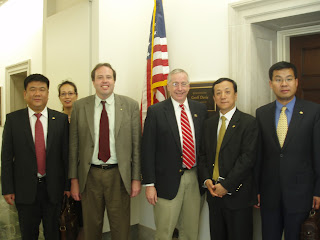
Meeting with Congressman Geoff Davis and delegation from Beijing representing China Association for International Friendly Contact, 29 June 2010
On June 29, 2010. Ralph E. Winnie, Jr., Director of the Eurasia
Center's China Program and Vice-President of Global Business
Development for the Eurasian Business Coalition is pictured with
Congressman Geoff Davis (Ky-4th) and several members of the Beijing
delegation representing the China Association for International
Friendly Contact. Mr. Winnie, Jr. arranged for this delegation to meet
with several members of Congress to discuss US-China business
development as well as US foreign policy objectives and mutual
collaboration between China and United States on issues involving
international extremism, sectarianism and terrorism.

Center's China Program and Vice-President of Global Business
Development for the Eurasian Business Coalition is pictured with
Congressman Geoff Davis (Ky-4th) and several members of the Beijing
delegation representing the China Association for International
Friendly Contact. Mr. Winnie, Jr. arranged for this delegation to meet
with several members of Congress to discuss US-China business
development as well as US foreign policy objectives and mutual
collaboration between China and United States on issues involving
international extremism, sectarianism and terrorism.


Friday, June 25, 2010
Russia's New Silicon Valley by Ralph Winnie, Jr.
http://www.divshare.com/download/18563473-bed
In an effort to boost Russia’s venture capital infrastructure and shift the Russian economy away from the oil and natural gas sector, Russian President Dmitri Medvedev has invested a tremendous
amount of political capital in pushing for the creation of a Russian high tech sector based on the
successful model of California’s Silicon Valley. President Medvedev echoes the new wave in Russian economic thinking that high tech is the quickest path to economic equality with the United States.
In advance of his trip to the United States, President Medvedev has
successfully lobbied many of the country’s billionaire elites to encourage
them to become supportive of innovative industries. The stated goal is for
Russia to attract billions of dollars in foreign direct investment , new
technologies and research and development in order to improve and
modernize Russia’s antiquated infrastructure and move the country away
from a commodity based system which has permeated the Russian
economy since 1991.
While several internationally renowned companies, like Cisco Systems and
Nokia, plan to take part in Russia’s “Silicon Valley” and the U.S. private
equity fund, Siguler Gruff, has agreed to invest $250 million in this high
tech park, many corporations and private equity firms,like Draper Fraser,
have openly expressed concerns regarding the age old stereotypes
confronting Russia. These include bribery, corruption and the method that
companies would be selected to be able to benefit from the incentives
claimed to be provided by this high tech zone.
Furthermore, another one of the major challenges that Medvedev will face
when selling the concept of Russia’s “Silicon Valley” to the United States,
is Russia’s lack of an abundance of research universities to ensure the
proper environment for start up companies to grow and develop. The
perception that the rule of law may be lacking in Russia and the
appearance of no effective and transparent legal framework for
businesses and investors are also additional hurdles that Medvedev may
have to overcome in the United States. The perception that the Russian
Government will steal technology and nationalize a successful start up
company is omnipresent in the minds of many American businessmen,
corporations and politicians alike.
Faced with this mentality in the United States, President Medvedev may
further be burdened by support among American venture capitalists for
the Start Up Visa Act of 2010 which is a new type of visa designed to
encourage foreign entrepreneurs and businesses to start companies in
the United States. If this new legislation passes Congress, a foreign born
businessmen would receive a two year visa if a qualified U.S. group of
investors (minimum amount of $100,000US in capital per investor)
contribute $250,000US into the start up venture of the entrepreneur in the
United States. After two years, this same entrepreneur would be allowed
permanent residency status upon proving that his business made $1
million US in revenue or created $1 million in foreign direct investment as
well as creating five full time jobs. Consequently, five of the ten U.S.
venture capital funds that recently travelled to Russia in May to tour the
high tech park have signed the “start up” visa support letter. This further
hampers Medvedev’s ability to attract foreign direct investment into Russia
at a critical time in its history.
Medvedev must clearly make the case in America that Russia’s “Silicon
Valley” will not be “overly hands on” and that the role of the Russian
government in matters involving the tech park would be limited to
infrastructure development and providing generous tax breaks and
various incentives , such as tax holidays, waiving of the corporate tax for a
fixed period of time and depreciation deductions on equipment. Medvedev
must also stress the fact that Russia has a strong history of excellence in
the scientific arena. He can point out that many of the high tech CEO’s
who have come to the United States and become very successful in
Silicon Valley were trained in Russian universities. Moscow State
University is known worldwide for its excellence in math and science and
has been referred to as the Harvard of Eastern Europe.
In response to criticisms that Russia has not developed a nationwide
network of technical universities, Medvedev can point out the successful
achievements of the MGU faculty and its student body. He can further
point to Russia’s successful efforts to integrate the scientific and technical
expertise of MGU graduates into high tech park which would serve to
convince many detractors that Russia is serious about its high tech
endeavors.
Furthermore, it would be wise for Medvedev to point out the advantage of
having a system of central planning in the high tech zone which would
make it easier to start up companies in Russia to receive zoning, financing
and tax breaks. Having the full support of the Russian government which
would closelymonitor the integration of the high tech zone with
technological innovation definitely goes along way in ensuring the
development and creation of the next Russian entrepreneur.
If Medvedev is unsuccessful in convincing the United States government
and American venture capitalists to invest in Russia’s “Silicon Valley”, the
People’s Republic of China would probably give serious consideration
towards encouraging their start up companies to invest in Russia’s high
tech zone. The Chinese have always viewed high tech as the quickest way
to achieve economic success and many projects under construction in
China have a high tech component.
China’s rapid growth and integration into the global economy represents a
major shift in the international global system which used to be dominated
by the United States and Western Europe. The opportunity for China and
Russia to develop a mutually collaborative business framework, with the
assistance of a plethora of research and development parks, heavily
influenced by China, would serve to enhance Russia’s reputation as a
global economic and political superpower. Recognition of Russia as a
superpower is something that President Medvedev expects from the West,
but he still has not received any acknowledgment or overt recognition to
that effect. Furthermore, while Medvedev fully expects the United States to
support Russia’s bid to join the WTO, he has repeatedly stated the
phrase,”Russia is fed up with being in the WTO waiting room” This
statement reflects years of frustration and anger on the part of many
leaders in Russia towards the United States who they sometimes view as
an arrogant hegemonist.
Consequently, China’s demands for oil and natural gas could easily be
satisfied through a collaborative business framework. Russia could
achieve its goal of becoming a player in the high tech world while China
gains political, regional and economic influence in Russia and Central Asia
as well as access to new markets for commodities.
In conclusion, the advent of a new high tech park in Russia’s “Silicon
Valley” presents many opportunities and challenges for President
Medvedev. If the United States decides to embrace the concept of a
Russian high tech park, it could allow Russia to emerge as a significant
ecnomic player in the world community with the advent of the next
generation of Russian entrepreneurs. However, suspicion and mistrust by
the United States towards Russia might encourage Medvedev to parter
with China which seeks to exert its own economic influence over Russia
and Central Asia.
Thursday, April 1, 2010
Introduction from Ralph Winnie Jr., Vice President of the Eurasia Center and
Ralph E. Winnie,
Jr.
Washington, D.C. T: 202-549-7928
F: 202-237-1452
The Eurasia Center
and its Eurasian Business Coalition is dedicated to promoting and preserving
the ideas of affordable housing, economic cooperation, environmental
sustainable development and the promotion of business development, tax and
trade between the United States
and the fifty nine nations comprising Eurasia .
As the Director of
the Eurasian Business Coalition’s China Program, Ralph E. Winnie, Jr. was
appointed by the Guangxi Investment Promotion Agency as Business Development Representative
for North America . He has been responsible for
the promotion of business development, tax and trade between Guangxi province
in the People’s Republic of China
and the United States .
Ralph has worked directly with clients who wanted to do business in Guangxi
province, arranging meetings with provincial government officials and the
Guangxi Investment Promotion Agency who have assisted him in helping to identify and locate
potential Chinese joint venture partners for clients. Ralph E. Winnie, Jr. has
also hosted high level delegations from Guangxi province in Washington ,
D.C. and organized a seminar for Guangxi
government officials to meet with individuals and business leaders who had an
interest in learning about business and cultural opportunities in China
in September 2005 and December 2007.
Ralph E. Winnie,
Jr. is responsible for advising domestic and foreign clients regarding
international tax minimization strategies and joint venture partnerships in China .
He has been a VIP guest of the Guangxi Investment Promotion Agency at the
annual China-ASEAN Exposition in Nanning ,
negotiating and establishing relationships with potential Chinese business partners
for firm clients. Ralph has been
interviewed and written up in the local Nanning Daily Press and has done live
interviews with CCTV. Ralph E. Winnie, Jr. also works with various coalition
and industry groups in Washington ,
D.C.
Finally, Ralph E.
Winnie, Jr. has extensive experience and expertise dealing with members of Congress , U.S. United
States for the Avoidance of Double Taxation
and the Prevention of Fiscal Evasion with respect to taxes on income and
capital. Ralph similarly assisted this same foreign governmental entity by
developing relationships with members of Congress in an effort to locate
medical equipment for the Army
Hospital
Ralph
E. Winnie, Jr. received an LL.M. in Taxation from Georgetown
University Law
Center in 2002 and graduated magna cum
laude from Jacob D. Fuchsberg
Law Center District
of Columbia and New York Bars and is admitted to
practice before the U.S. Supreme Court.
He studied international law at Oxford
University (Magdalen
College ) in Oxford ,
the United Kingdom and Moscow State
University in Moscow , Russia
Wednesday, March 24, 2010
Article by Ralph Winnie, Jr., Contributing Editor of Washington Post and Russia Now on March 24th 2010
Iran is fast becoming one of Russia's best business clients. While Russia is not entirely comfortable with Iran acquiring advanced nuclear technology and is concerned about combating terrorism, Russia is more concerned about becoming a broker in the Middle East, independent of the West. Strategic economic relations with Iran are quickly becoming a top priority.
Last month, Oleg Rozhkov, the deputy director of the Russian Foreign Ministry’s security affairs and disarmament department, made it clear that Russia would only consider sanctions against Iran that are “directed at resolving nonproliferation questions linked to Iran’s nuclear program.” Rozhkov further mentioned to reporters in Moscow that “we are not going to work on sanctions or measures which could lead to the political or economic or financial isolation of this country.”
Since it is established that Iran holds 16 percent of the world’s gas reserves and 11 percent of the world’s oil reserves, Iran’s oil and gas sectors offer many opportunities for Russian investment, from government agencies down to private entrepreneurs. As Russia seeks to cultivate Iran and competes for influence in the Middle East, Iran and Russia have held high-level discussions on coordination of Iranian gas exports with Gazprom, Russia’s largest state-owned oil and gas conglomerate. Such a deal shuts the United States and Western Europe out of the competition for these increasingly valuable natural resources, and further encourages the development of a potential strategic alliance between Iran and Russia. However, Russia could become a major player in this region over the next several years by helping Iran to develop newer oil supplies and to increase the productivity of its older oil fields, assisting Iran in achieving its objective as an exporter of natural gas.
Consequently, to help its cash-strapped military and nuclear establishment, Russia has sold submarines and weapons to Iran and signed a contract to construct a civilian nuclear reactor in Bushehr, which was eventually sold for $800 million. This allowed Russia to cut a deal with Iran by promising to give them a favorable price on fuel if Iran would allow Russia to help build and improve infrastructure.
Since NATO’s decision to admit new Eastern European members, Russian hard-liners have consistently and successfully pressured the Russian government to respond by forming new alliances with Iran and emerging Third World countries. Furthermore, Russia subscribes to the belief that easing sanctions on oil and gas and allowing banking activities with Iran will serve to further Russia’s interest in the development of oil in the Caspian Sea, which would boost Russia’s exports to Asia and help to stabilize oil supplies and prices worldwide.
At a time when countries are competing among themselves to ensure more diverse and reliable sources of energy, Russia views Iran as a vehicle for the improvement of Russia’s economy, which deteriorated rapidly during the transition from the Soviet era to today’s quasi capitalism. Allowing a Russian company, like Gazprom, to coordinate petroleum exports in Iran reinforces Russia’s belief that Iran is verging on client status, whose continued cooperation is critical for stability in the Middle East and for the protection of Russian influence in that region. This attitude is reinforced by the attempt on the part of the United States to assist ex-Soviet states, which rely on Russian pipelines to export their oil and gas, to build oil and gas pipelines that are outside the control of Russia. Moscow believes this to be a deliberate attempt by the West to isolate and weaken Russia. Thus, the strategic relationship between Iran and Russia reinforces Russia’s economic interests.
As Russia and Iran together control over 20 percent of the world’s oil reserves and nearly half of the world’s gas reserves, a strong and viable strategic relationship, guided by mutually beneficial economic interests, may serve to prevent Iranian energy resources from falling into the hands of the United States and European consumers. At the same time, financing profitable projects, like Gazprom, will create a greater level of dependence by many Asian countries, including China, on Iran. This would greatly aid Russia in achieving its goal of once again becoming a global superpower by focusing on the areas of trade, investment and military capabilities in the Middle East.
Since sanctions on Iran have diminished expectations of Western investment in that country, American engagement, which has traditionally been very effective in allowing the private sector to invest in countries like Iran and make American products and ideas available, has no practical applicability toward changing the mindset of the hard-line fundamentalist regime. Shutting the United States out of the ability to develop Iran’s vast oil and gas reserves prevents the United States from being recognized as a geo-political player in this region and plays strongly in Russia’s favor. Unlike the United States, Russia chooses to focus on energy and economic interests, thereby creating a formidable strategic and economic relationship between Iran and Russia that might change the dynamics of the Middle East.
Subscribe to:
Posts (Atom)